Showing posts with label pictures. Show all posts
Showing posts with label pictures. Show all posts
Friday, May 13, 2011

Monday, May 9, 2011
hello babies. welcome to earth.
i attended a lovely wedding in edinburgh a few weeks ago. men wore kilts, we danced ceilidh, and several excellent quotes by kurt vonnegut were read during the humanist ceremony. here's a quote that stuck with me, followed by a few photos surrounding the event...
'Hello babies. Welcome to Earth. It's hot in the summer and cold in the winter. It's round and wet and crowded. On the outside, babies, you've got a hundred years here. There's only one rule that I know of, babies -
"God damn it, you've got to be kind." '
- kurt vonnegut


'Hello babies. Welcome to Earth. It's hot in the summer and cold in the winter. It's round and wet and crowded. On the outside, babies, you've got a hundred years here. There's only one rule that I know of, babies -
"God damn it, you've got to be kind." '
- kurt vonnegut


Wednesday, May 4, 2011
one last look
today is my final full day in greece before i make the long trip back to the land down under tomorrow. it has certainly been an adventurous and exhausting 6 weeks. i woke up sore today, but all i did yesterday was sit on a ferry for nine hours returning to athens from santorini island?

thanks to all old friends i caught up with and new folks i've met on this trip. it has been memorable, productive, fun, and exhausting. i should have scheduled a short holiday from my holiday, but after i return to sydney on saturday, i give a talk on monday!?! i'll think about that on the plane...

thanks to all old friends i caught up with and new folks i've met on this trip. it has been memorable, productive, fun, and exhausting. i should have scheduled a short holiday from my holiday, but after i return to sydney on saturday, i give a talk on monday!?! i'll think about that on the plane...
Thursday, April 28, 2011
parthenon: ancient legos
i started my official holiday today - in greece! i probably wont be posting much over the next week, but i couldnt resist sharing some photos from a walk up to the acropolis of athens today.


is it just me, or does the parthenon look like it was put together with stone legos? ;)


Γειά σας!


is it just me, or does the parthenon look like it was put together with stone legos? ;)


Γειά σας!
Tuesday, April 26, 2011
heidelberg, germany
two weeks ago i visited the lovely city of heidelberg, germany and the max planck institute for astronomy (MPIA) located on top of a mountain overlooking heidelberg.
the little city has a very large castle!


and a big river with an old bridge to walk across.


i love the coziness of restaurants that serve german food, i just wish i would have thought to take this photo when the plate was still full with yummy spätzle and meat.

after a nice journey up the steep hill ("berg" = mountain) in a funicular, we saw some lovely views and walked the rest of the way to MPIA through a forest.

just next to the MPIA, a building is being constructed in the shape of a spiral galaxy (!!) and will host the haus der astronomie - an exciting organization dedicated to teaching astronomy to school children and adults all over the german-speaking world!

i was lucky enough to get a full tour :)

the little city has a very large castle!


and a big river with an old bridge to walk across.


i love the coziness of restaurants that serve german food, i just wish i would have thought to take this photo when the plate was still full with yummy spätzle and meat.

after a nice journey up the steep hill ("berg" = mountain) in a funicular, we saw some lovely views and walked the rest of the way to MPIA through a forest.

just next to the MPIA, a building is being constructed in the shape of a spiral galaxy (!!) and will host the haus der astronomie - an exciting organization dedicated to teaching astronomy to school children and adults all over the german-speaking world!

i was lucky enough to get a full tour :)

Sunday, April 24, 2011

Tuesday, April 12, 2011
mangle with a clear conscience!
i'm currenty in cardiff, wales to give a talk at cardiff university. while exploring the city, guess what we found inside this cool building...

did you guess?
a penny smasher!!!

but not to worry... we can all mangle with a clear conscience :)

cardiff is a city where the buildings have hats.

and face boats. (?)

and it's by the sea! look, i think that's england!


did you guess?
a penny smasher!!!

but not to worry... we can all mangle with a clear conscience :)

cardiff is a city where the buildings have hats.

and face boats. (?)

and it's by the sea! look, i think that's england!

Tuesday, April 5, 2011
dotAstronomy - Oxford, UK
the third dotAstronomy conference is well underway in oxford's new college! i'll have exciting results to reveal tomorrow from this year's hack day, but for now, here are a few photos of the harry-potter-like venue!


Thursday, March 10, 2011
rainbow panorama
remember that bright rainbow that appeared last week at the observatory? i finally got the panorama together. actually, thats a lie. what i did was mention the idea of the panorama to a fellow astronomer that i was observing with and he offered to do the whole thing in photoshop ;) it took him about 30 minutes and the result is stunning (click to see a larger version)...

muchas gracias el lobo rayado!

muchas gracias el lobo rayado!
Tuesday, March 8, 2011
sunset over warrumbungle park
siding springs observatory sits inside the warrumbungle national park. sometimes the sunsets over the park are incredible.


Tuesday, March 1, 2011
rainbow bright
the first stretch of this long observing run is over. i've had a few hours of sleep, and i'm off to the town of mudgee for a couple days to relax and visit several local wineries! the last time i stopped in mudgee, i had lunch at a resturant called "fish in the bush" (tee hee ;)
clouds are generally bad for using telescopes, obviously, but they often produce interesting terrestrial phenomena. the same night we saw the moon next to venus, we also saw a brilliant morning double rainbow!
at one point, both bows stretched around to make 3/4 of a full circle. it was stunning, but i couldnt fit it all into one photo (wish i had a fish-eye lens!). i took a lot of photos that i'd like to try to mosaic together - any recommendations for software to use to do this?
in the meantime, enjoy!


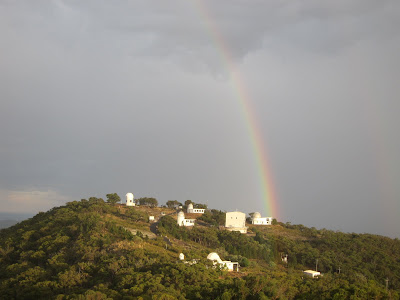
clouds are generally bad for using telescopes, obviously, but they often produce interesting terrestrial phenomena. the same night we saw the moon next to venus, we also saw a brilliant morning double rainbow!
at one point, both bows stretched around to make 3/4 of a full circle. it was stunning, but i couldnt fit it all into one photo (wish i had a fish-eye lens!). i took a lot of photos that i'd like to try to mosaic together - any recommendations for software to use to do this?
in the meantime, enjoy!


Monday, February 14, 2011
determining redshifts
determining how far away an object in the universe is from the earth is one of the most difficult tasks astronomers face, and also one of the most important. because the light from distant objects is the only signal we know how to receive from them with current technologies, we need to know how far away they are in order to determine how intrinsically bright they are. once we know that fundamental piece of information we can start to deduce all sorts of funky and interesting information about them!
there is a series of ways that astronomers use to determine distances to celestial objects, which is described as the "cosmic distance ladder." if an object is sufficiently far away (more than a few million light years - a criterion satisfied by all galaxies in the universe except andromeda and the little guys in our local group), we can measure its redshift. the cosmological redshift is a measure of how much a wavelength of light from a distant galaxy has stretched due to the expansion of the universe since the galaxy's stars emitted the light that is finally now reaching earth. whew! go read THIS for an explanation of redshift if you want...
in order to determine a solid redshift, you have to know how far light from a galaxy has shifted in wavelength. the best way to do this is to look at the galaxy's spectrum to identify specific spectral features (e.g. hydrogen, oxygen, etc...) whose patterns are all shifted to longer wavelengths. when i was at the telescope last week, we were observing spectra of 400 galaxies an hour (in clear weather) and then determining their redshifts as we went. here are some examples of the practice in action...

someone in the collaboration expanded a fancy little bit of code that shows the galaxy spectrum (in white) and allows one to display template spectra of well-known galaxy types (green) shifted to the potential redshift of the observed galaxy. (click image to enlarge). the X axis (horizontal) shows the wavelength scale (the discrete energies of the photons received by the telescope) and the Y axis (vertical) shows the amount of photons received at each of those discrete wavelengths.
to determine the exact redshift, you match as many features as you can, like the overall shape of the spectrum, the well-known dips (like calcium H and K that are very close to each other at about 4500 angstroms in the above spectrum), or the more obvious spikes ("emission lines"), if you happen to get strong ones like in the example below.

some galaxies have spectral features that are very strong and easy to identify, but others look noisy and its not obvious at all if there are any features. to be absolutely sure of a redshift, we can take a guess at the redshift and then look more closely at several regions where there should be spectral features if they are present in the galaxy and if the galaxy is at the guessed redshift.

its amazing to sit back and think that each one of these spectra are composite collections of light created by hundreds of billions of stars gravitationally bound together in a single swirling galaxy, probably not unlike our own milky way home. but i have to admit, when every singe hour of observations produces a collection of 400 galaxy spectra to determine redshifts for, my eyes feel exhausted and strained at the end of a long night at the telescope!
luckily during our recent observing run, we had quite a few people in the telescope dome (note the unusually high female to male ratio :)

and we could therefore be a bit more leisurely during our redshifting sessions!!

there is a series of ways that astronomers use to determine distances to celestial objects, which is described as the "cosmic distance ladder." if an object is sufficiently far away (more than a few million light years - a criterion satisfied by all galaxies in the universe except andromeda and the little guys in our local group), we can measure its redshift. the cosmological redshift is a measure of how much a wavelength of light from a distant galaxy has stretched due to the expansion of the universe since the galaxy's stars emitted the light that is finally now reaching earth. whew! go read THIS for an explanation of redshift if you want...
in order to determine a solid redshift, you have to know how far light from a galaxy has shifted in wavelength. the best way to do this is to look at the galaxy's spectrum to identify specific spectral features (e.g. hydrogen, oxygen, etc...) whose patterns are all shifted to longer wavelengths. when i was at the telescope last week, we were observing spectra of 400 galaxies an hour (in clear weather) and then determining their redshifts as we went. here are some examples of the practice in action...

someone in the collaboration expanded a fancy little bit of code that shows the galaxy spectrum (in white) and allows one to display template spectra of well-known galaxy types (green) shifted to the potential redshift of the observed galaxy. (click image to enlarge). the X axis (horizontal) shows the wavelength scale (the discrete energies of the photons received by the telescope) and the Y axis (vertical) shows the amount of photons received at each of those discrete wavelengths.
to determine the exact redshift, you match as many features as you can, like the overall shape of the spectrum, the well-known dips (like calcium H and K that are very close to each other at about 4500 angstroms in the above spectrum), or the more obvious spikes ("emission lines"), if you happen to get strong ones like in the example below.

some galaxies have spectral features that are very strong and easy to identify, but others look noisy and its not obvious at all if there are any features. to be absolutely sure of a redshift, we can take a guess at the redshift and then look more closely at several regions where there should be spectral features if they are present in the galaxy and if the galaxy is at the guessed redshift.

its amazing to sit back and think that each one of these spectra are composite collections of light created by hundreds of billions of stars gravitationally bound together in a single swirling galaxy, probably not unlike our own milky way home. but i have to admit, when every singe hour of observations produces a collection of 400 galaxy spectra to determine redshifts for, my eyes feel exhausted and strained at the end of a long night at the telescope!
luckily during our recent observing run, we had quite a few people in the telescope dome (note the unusually high female to male ratio :)

and we could therefore be a bit more leisurely during our redshifting sessions!!

Saturday, February 5, 2011
intense observing
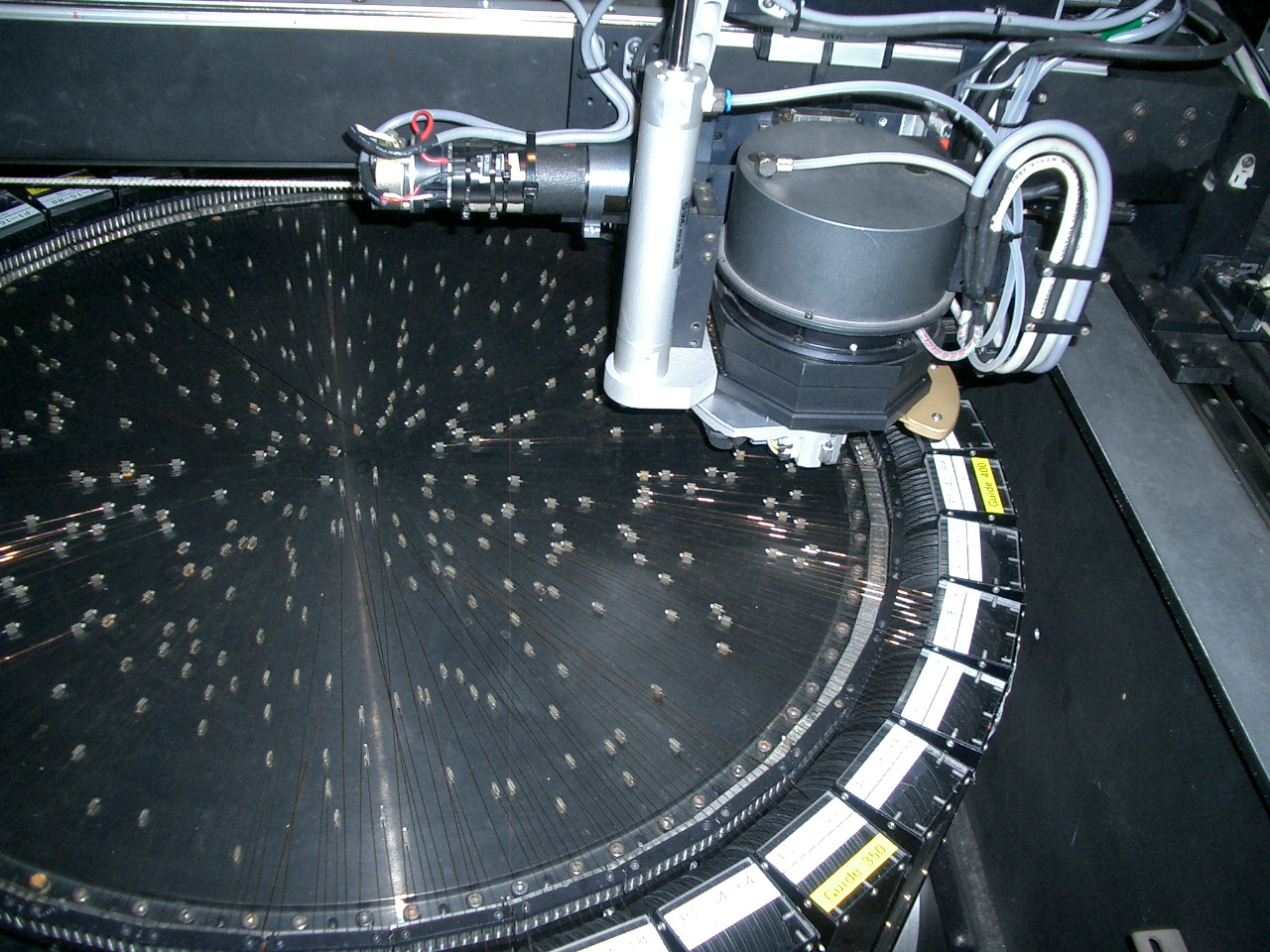
as you can see, i havent been able to post nearly as much as i was hoping during this observing run at the AAO. it turns out this telescope and observing project require a lot more attention than i had predicted. it takes three people to keep operations going: a "night assistant" to control the telescope (make sure it continues pointing in the right direction, monitor the weather), a "support astronomer" to operate the instrument (keep everything in focus, configure the 400 optical fiber positions before each observation, actually open the camera's shutter), and the "observer" to decide what targets to look at and make sure the data is top quality throughout the night.
i'm feeling fairly exhausted from the whole ordeal even though these are short summer nights! during this run i'm training to do both the support tasks and those of the observer and at the end of this month i will spend a few nights as the head support astronomer!
for now, here are some photos.
these mountains are littered with telescopes and i just found out there are plans to build about 14 more small-ish ones over the next several years!

butterflies love bottle brush.

the view from the catwalk of the AAT.

the AAT.

the control room setup is not quite as impressive as at UKIRT on mauna kea, but it certainly accomplishes the goals.

the night assistant in his rest state.


no matter how much i want to complain about brutal observing and not having as much time as i was hoping to work on science during the nights, i cannot complain at all about having time after i eat dinner to go out and watch kangaroos eat grass and bounce around. they are so freaking adorable... and when they hop away, i cant help but smile.


i'm feeling fairly exhausted from the whole ordeal even though these are short summer nights! during this run i'm training to do both the support tasks and those of the observer and at the end of this month i will spend a few nights as the head support astronomer!
for now, here are some photos.
these mountains are littered with telescopes and i just found out there are plans to build about 14 more small-ish ones over the next several years!

butterflies love bottle brush.

the view from the catwalk of the AAT.

the AAT.

the control room setup is not quite as impressive as at UKIRT on mauna kea, but it certainly accomplishes the goals.

the night assistant in his rest state.


no matter how much i want to complain about brutal observing and not having as much time as i was hoping to work on science during the nights, i cannot complain at all about having time after i eat dinner to go out and watch kangaroos eat grass and bounce around. they are so freaking adorable... and when they hop away, i cant help but smile.


Subscribe to:
Posts (Atom)