i studied for my PhD in austin, texas and spent several months at the mcdonald observatory in west texas. i saw many beautiful thunderstorms and even some smoke plumes during my observing stints, but never did a full-fledged wildfire threaten the safety of people nearby.
that all changed several days ago when a devastating wildfire blasted through the nearby town of ft. davis. the observatory shared this incredible photo:
shown is the 107-inch telescope, the one i've used for a cumulative 4 months or so, as viewed from the catwalk of the 82-inch telescope that was built in the 1930s!
as of now, the observatory is safe, but here is a link for info on the current texas wildfire situation. best wishes to all!
UPDATE:
the NY Times posted an article with the images below included:
Showing posts with label observing. Show all posts
Tuesday, April 12, 2011
Thursday, March 10, 2011
rainbow panorama
remember that bright rainbow that appeared last week at the observatory? i finally got the panorama together. actually, thats a lie. what i did was mention the idea of the panorama to a fellow astronomer that i was observing with and he offered to do the whole thing in photoshop ;) it took him about 30 minutes and the result is stunning (click to see a larger version)...
muchas gracias el lobo rayado!
Labels:
astrophotography,
australia,
nature,
observing,
pictures
Wednesday, March 9, 2011
bye bye kangaroos!
back to the big city today... just as well as there are rain storms all around!
the best kangaroo moment this week happened three days ago. as i was walking along the path between the telescope and the hotel-style rooms, a couple kangaroos were sitting next to the path, mindlessly chomping away at grass. as usual, one of them looked up at me as if i was just a harmless creature passing by. but the little one startled at the sight of me and turned to bound away in haste. after one bounce, the poor thing landed on some loose brush, lost his footing and completely wiped out! i had to stop in my tracks to laugh because he looked so awkwardly funny! his head popped up instantly from his splattered position on the ground and he looked around as if disoriented. then he quickly jumped up and bounded off a few bounces in a different direction, but friend just remained still watching the whole scene, chomping away.
they're such cute little clueless creatures.
the best kangaroo moment this week happened three days ago. as i was walking along the path between the telescope and the hotel-style rooms, a couple kangaroos were sitting next to the path, mindlessly chomping away at grass. as usual, one of them looked up at me as if i was just a harmless creature passing by. but the little one startled at the sight of me and turned to bound away in haste. after one bounce, the poor thing landed on some loose brush, lost his footing and completely wiped out! i had to stop in my tracks to laugh because he looked so awkwardly funny! his head popped up instantly from his splattered position on the ground and he looked around as if disoriented. then he quickly jumped up and bounded off a few bounces in a different direction, but friend just remained still watching the whole scene, chomping away.
they're such cute little clueless creatures.
Tuesday, March 8, 2011
sunset over warrumbungle park
siding springs observatory sits inside the warrumbungle national park. sometimes the sunsets over the park are incredible.
Sunday, March 6, 2011
invaders have landed at siding springs observatory!
many observatories have an all-sky camera in place to help monitor the cloud levels throughout the night. they are incredibly useful and also beautiful when you can see the milky way galaxy stretched overhead.
sometimes they have even detected critters crawling across our known universe! ;)
this photo was spotted the other night by a fellow astronomer up here at the AAT this run.
sometimes they have even detected critters crawling across our known universe! ;)
this photo was spotted the other night by a fellow astronomer up here at the AAT this run.
Friday, March 4, 2011
the UK Schmidt Telescope
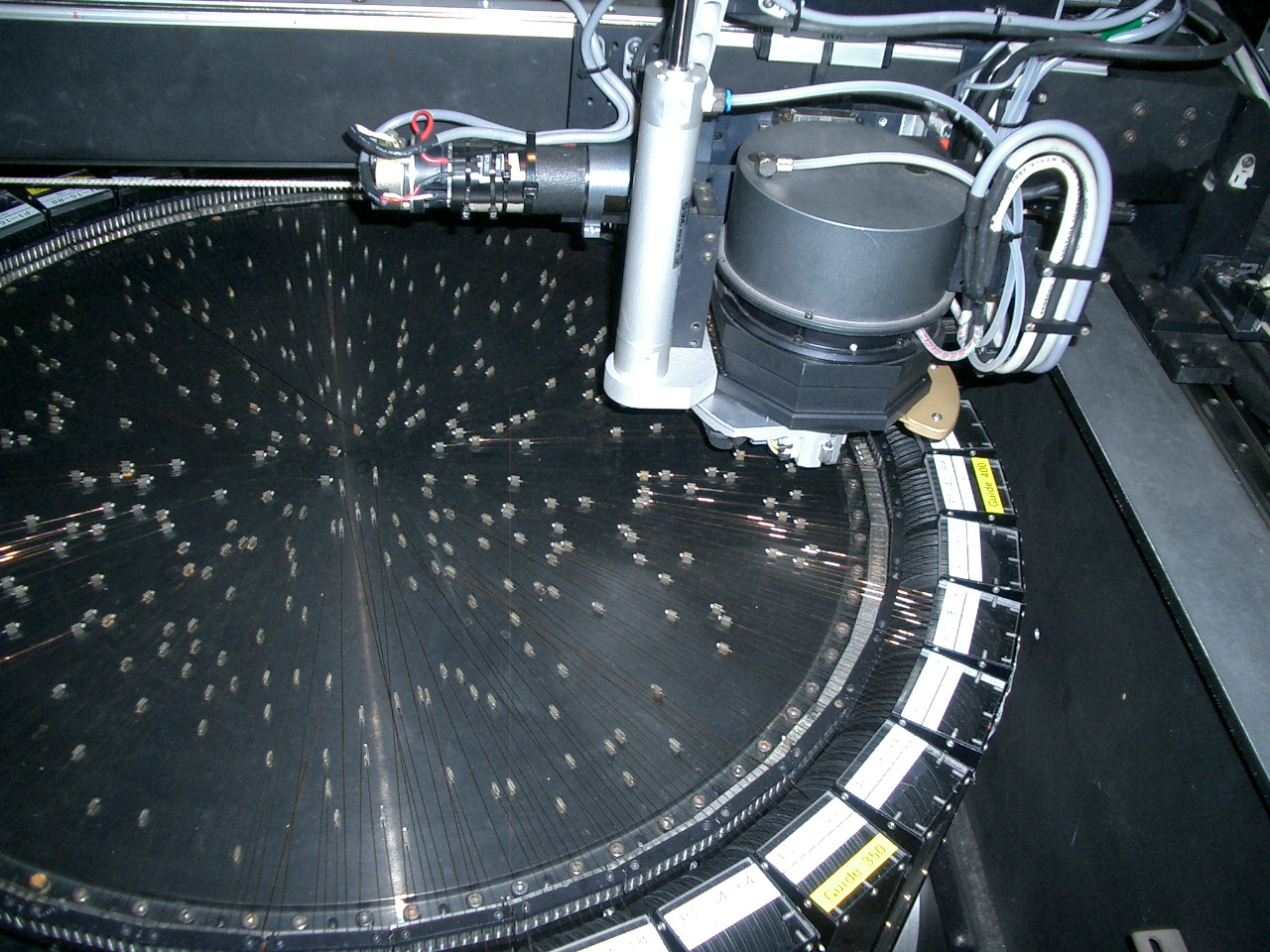
just across the mountain from the AAT lives the UK Schmidt telescope, a 1.2 meter scope built in the early 1970s. in the photo below, the UKST is the dome on the left as seen from the catwalk of the AAT.
solid 70s construction (the tape is not part of the support structure ;)
the rooms inside this telescope dome feel like museums of old equipment and techniques in astronomy. this is the original analog mini-dome model that is still in control of moving the opening of the dome relative to where the telescope points.
while we can make much more precise measurements with digital CCD technology, there's something romantic about investigating old developed images.
nowadays, the UKST is used to survey the sky and collect velocities of 1 million stars zooming around our milky way galaxy for a project called RAVE. this robot works hard to position all optical fiber on the heavy plates in order to collect spectra of each individual star.
here's an old note i found in the dome...
solid 70s construction (the tape is not part of the support structure ;)
the rooms inside this telescope dome feel like museums of old equipment and techniques in astronomy. this is the original analog mini-dome model that is still in control of moving the opening of the dome relative to where the telescope points.
while we can make much more precise measurements with digital CCD technology, there's something romantic about investigating old developed images.
nowadays, the UKST is used to survey the sky and collect velocities of 1 million stars zooming around our milky way galaxy for a project called RAVE. this robot works hard to position all optical fiber on the heavy plates in order to collect spectra of each individual star.
here's an old note i found in the dome...
Tuesday, March 1, 2011
rainbow bright
the first stretch of this long observing run is over. i've had a few hours of sleep, and i'm off to the town of mudgee for a couple days to relax and visit several local wineries! the last time i stopped in mudgee, i had lunch at a resturant called "fish in the bush" (tee hee ;)
clouds are generally bad for using telescopes, obviously, but they often produce interesting terrestrial phenomena. the same night we saw the moon next to venus, we also saw a brilliant morning double rainbow!
at one point, both bows stretched around to make 3/4 of a full circle. it was stunning, but i couldnt fit it all into one photo (wish i had a fish-eye lens!). i took a lot of photos that i'd like to try to mosaic together - any recommendations for software to use to do this?
in the meantime, enjoy!
clouds are generally bad for using telescopes, obviously, but they often produce interesting terrestrial phenomena. the same night we saw the moon next to venus, we also saw a brilliant morning double rainbow!
at one point, both bows stretched around to make 3/4 of a full circle. it was stunning, but i couldnt fit it all into one photo (wish i had a fish-eye lens!). i took a lot of photos that i'd like to try to mosaic together - any recommendations for software to use to do this?
in the meantime, enjoy!
Monday, February 28, 2011
the integral of the moon and venus
just before the sun rises for the next couple days, you can see the crescent moon close to a bright venus. we had clouds for most of our observing tonight, but they cleared for just a few minutes this morning, long enough to see the spectacle in our solar system!
while out on the catwalk, i also noticed a sign in the clouds... what looked to me to be an integral sign! ;)
Sunday, February 27, 2011
Friday, February 25, 2011
coonabarabran
just arrived at siding springs observatory for another round of observing with the anglo-australian telescope.
there isnt a whole lot of excitement during the seven hour drive through the bush to get here, regardless of whether you take the hunter valley route or the mudgee route. but i must say, i am highly amused by the place names around new south wales!
i remember driving around the UK and being utterly confused as to how anyone was supposed to know the proper way to pronounce place names. for example, Leicester is "Les-tah," Belvoir is "beaver" (i'm not joking, and made the mistake of using this pronunciation in australia. the horror!), Loughborough is "luff-buh-ruh." actually, anything with an "ough" in it is pointless to even try. just wait to hear someone say it. especially edinburgh.
apparently a common mispronunciation of Loughborough, especially among australians, is "looga-burooga." having done some driving around this part of australia, it's clear that a lot of place names maintain their aboriginal origin and are pronounced mostly phonetically. so if the word has a lot of letters, like coonabarabran, you just take your time, pronounce all the letters, and it sounds exactly as it looks. or, in true australian fashion, you just shorten the word. so instead of saying the 5 syllables of coon-a-bear-a-bran every time, you just say coona.
coona is the closest town to the observatory and also happens to have one of the best names i've encountered yet! but on the drive today we also passed by dunedoo, wallerawang, cullen bullen, and marrangaroo :)
there isnt a whole lot of excitement during the seven hour drive through the bush to get here, regardless of whether you take the hunter valley route or the mudgee route. but i must say, i am highly amused by the place names around new south wales!
i remember driving around the UK and being utterly confused as to how anyone was supposed to know the proper way to pronounce place names. for example, Leicester is "Les-tah," Belvoir is "beaver" (i'm not joking, and made the mistake of using this pronunciation in australia. the horror!), Loughborough is "luff-buh-ruh." actually, anything with an "ough" in it is pointless to even try. just wait to hear someone say it. especially edinburgh.
apparently a common mispronunciation of Loughborough, especially among australians, is "looga-burooga." having done some driving around this part of australia, it's clear that a lot of place names maintain their aboriginal origin and are pronounced mostly phonetically. so if the word has a lot of letters, like coonabarabran, you just take your time, pronounce all the letters, and it sounds exactly as it looks. or, in true australian fashion, you just shorten the word. so instead of saying the 5 syllables of coon-a-bear-a-bran every time, you just say coona.
coona is the closest town to the observatory and also happens to have one of the best names i've encountered yet! but on the drive today we also passed by dunedoo, wallerawang, cullen bullen, and marrangaroo :)
Monday, February 14, 2011
determining redshifts
determining how far away an object in the universe is from the earth is one of the most difficult tasks astronomers face, and also one of the most important. because the light from distant objects is the only signal we know how to receive from them with current technologies, we need to know how far away they are in order to determine how intrinsically bright they are. once we know that fundamental piece of information we can start to deduce all sorts of funky and interesting information about them!
there is a series of ways that astronomers use to determine distances to celestial objects, which is described as the "cosmic distance ladder." if an object is sufficiently far away (more than a few million light years - a criterion satisfied by all galaxies in the universe except andromeda and the little guys in our local group), we can measure its redshift. the cosmological redshift is a measure of how much a wavelength of light from a distant galaxy has stretched due to the expansion of the universe since the galaxy's stars emitted the light that is finally now reaching earth. whew! go read THIS for an explanation of redshift if you want...
in order to determine a solid redshift, you have to know how far light from a galaxy has shifted in wavelength. the best way to do this is to look at the galaxy's spectrum to identify specific spectral features (e.g. hydrogen, oxygen, etc...) whose patterns are all shifted to longer wavelengths. when i was at the telescope last week, we were observing spectra of 400 galaxies an hour (in clear weather) and then determining their redshifts as we went. here are some examples of the practice in action...
someone in the collaboration expanded a fancy little bit of code that shows the galaxy spectrum (in white) and allows one to display template spectra of well-known galaxy types (green) shifted to the potential redshift of the observed galaxy. (click image to enlarge). the X axis (horizontal) shows the wavelength scale (the discrete energies of the photons received by the telescope) and the Y axis (vertical) shows the amount of photons received at each of those discrete wavelengths.
to determine the exact redshift, you match as many features as you can, like the overall shape of the spectrum, the well-known dips (like calcium H and K that are very close to each other at about 4500 angstroms in the above spectrum), or the more obvious spikes ("emission lines"), if you happen to get strong ones like in the example below.
some galaxies have spectral features that are very strong and easy to identify, but others look noisy and its not obvious at all if there are any features. to be absolutely sure of a redshift, we can take a guess at the redshift and then look more closely at several regions where there should be spectral features if they are present in the galaxy and if the galaxy is at the guessed redshift.
its amazing to sit back and think that each one of these spectra are composite collections of light created by hundreds of billions of stars gravitationally bound together in a single swirling galaxy, probably not unlike our own milky way home. but i have to admit, when every singe hour of observations produces a collection of 400 galaxy spectra to determine redshifts for, my eyes feel exhausted and strained at the end of a long night at the telescope!
luckily during our recent observing run, we had quite a few people in the telescope dome (note the unusually high female to male ratio :)
and we could therefore be a bit more leisurely during our redshifting sessions!!
there is a series of ways that astronomers use to determine distances to celestial objects, which is described as the "cosmic distance ladder." if an object is sufficiently far away (more than a few million light years - a criterion satisfied by all galaxies in the universe except andromeda and the little guys in our local group), we can measure its redshift. the cosmological redshift is a measure of how much a wavelength of light from a distant galaxy has stretched due to the expansion of the universe since the galaxy's stars emitted the light that is finally now reaching earth. whew! go read THIS for an explanation of redshift if you want...
in order to determine a solid redshift, you have to know how far light from a galaxy has shifted in wavelength. the best way to do this is to look at the galaxy's spectrum to identify specific spectral features (e.g. hydrogen, oxygen, etc...) whose patterns are all shifted to longer wavelengths. when i was at the telescope last week, we were observing spectra of 400 galaxies an hour (in clear weather) and then determining their redshifts as we went. here are some examples of the practice in action...
someone in the collaboration expanded a fancy little bit of code that shows the galaxy spectrum (in white) and allows one to display template spectra of well-known galaxy types (green) shifted to the potential redshift of the observed galaxy. (click image to enlarge). the X axis (horizontal) shows the wavelength scale (the discrete energies of the photons received by the telescope) and the Y axis (vertical) shows the amount of photons received at each of those discrete wavelengths.
to determine the exact redshift, you match as many features as you can, like the overall shape of the spectrum, the well-known dips (like calcium H and K that are very close to each other at about 4500 angstroms in the above spectrum), or the more obvious spikes ("emission lines"), if you happen to get strong ones like in the example below.
some galaxies have spectral features that are very strong and easy to identify, but others look noisy and its not obvious at all if there are any features. to be absolutely sure of a redshift, we can take a guess at the redshift and then look more closely at several regions where there should be spectral features if they are present in the galaxy and if the galaxy is at the guessed redshift.
its amazing to sit back and think that each one of these spectra are composite collections of light created by hundreds of billions of stars gravitationally bound together in a single swirling galaxy, probably not unlike our own milky way home. but i have to admit, when every singe hour of observations produces a collection of 400 galaxy spectra to determine redshifts for, my eyes feel exhausted and strained at the end of a long night at the telescope!
luckily during our recent observing run, we had quite a few people in the telescope dome (note the unusually high female to male ratio :)
and we could therefore be a bit more leisurely during our redshifting sessions!!
Saturday, February 5, 2011
intense observing
as you can see, i havent been able to post nearly as much as i was hoping during this observing run at the AAO. it turns out this telescope and observing project require a lot more attention than i had predicted. it takes three people to keep operations going: a "night assistant" to control the telescope (make sure it continues pointing in the right direction, monitor the weather), a "support astronomer" to operate the instrument (keep everything in focus, configure the 400 optical fiber positions before each observation, actually open the camera's shutter), and the "observer" to decide what targets to look at and make sure the data is top quality throughout the night.
i'm feeling fairly exhausted from the whole ordeal even though these are short summer nights! during this run i'm training to do both the support tasks and those of the observer and at the end of this month i will spend a few nights as the head support astronomer!
for now, here are some photos.
these mountains are littered with telescopes and i just found out there are plans to build about 14 more small-ish ones over the next several years!
butterflies love bottle brush.
the view from the catwalk of the AAT.
the AAT.
the control room setup is not quite as impressive as at UKIRT on mauna kea, but it certainly accomplishes the goals.
the night assistant in his rest state.
no matter how much i want to complain about brutal observing and not having as much time as i was hoping to work on science during the nights, i cannot complain at all about having time after i eat dinner to go out and watch kangaroos eat grass and bounce around. they are so freaking adorable... and when they hop away, i cant help but smile.
i'm feeling fairly exhausted from the whole ordeal even though these are short summer nights! during this run i'm training to do both the support tasks and those of the observer and at the end of this month i will spend a few nights as the head support astronomer!
for now, here are some photos.
these mountains are littered with telescopes and i just found out there are plans to build about 14 more small-ish ones over the next several years!
butterflies love bottle brush.
the view from the catwalk of the AAT.
the AAT.
the control room setup is not quite as impressive as at UKIRT on mauna kea, but it certainly accomplishes the goals.
the night assistant in his rest state.
no matter how much i want to complain about brutal observing and not having as much time as i was hoping to work on science during the nights, i cannot complain at all about having time after i eat dinner to go out and watch kangaroos eat grass and bounce around. they are so freaking adorable... and when they hop away, i cant help but smile.
Thursday, February 3, 2011
telescope domes and kangaroos!
its one of those fantastic new moon, pitch black nights where you cant see your hand in front of your face. unfortunately, the sky is also covered in clouds so i cant see any stars :( but i managed to see some kangaroos and take some photos before the sun went down!
the anglo-australian telescope:
the Faulkes Telescope South:
the anglo-australian telescope:
the Faulkes Telescope South:
Wednesday, February 2, 2011
the australian astronomical observatory
i've been working for the anglo australian observatory out of the sydney offices since november 2010 and today i finally get to drive out to the observatory and meet some new big telescopes! for the next four nights and several more later this month, i will be learning to use the anglo-australian telescope (AAT).
in this photo from 1979 you can see the AAT and star trails around the southern celestial pole. you can also see squiggly lines on the catwalk around the telescope created by the flashlight of an astronomer checking the weather during this long exposure...
with a 4 meter diameter primary mirror, the AAT is no longer one of the largest telescopes on the surface of the earth, but it has remained an astronomical work horse since the mid 1970s, when it was built as the first major telescope in the southern hemisphere.
for a nice little video summary of some of the most influential science discoveries produced by the AAT, CLICK HERE!! the project they mention near the end of the video, called GAMA, is the one i'm working on. hopefully, i'll get to write more this week about what i'm doing at the telescope and the research i'm doing in australia and with GAMA.
for now... its time to drive over 7 hours to the northwest to reach the observatory. we're currently sitting under heavy clouds, but even after driving 400 km north, we'll be decently far away from last night's intense cyclone yasi. as you can see on this map, yasi hit in northern queensland, while the observatory sits solidly in new south wales. sending out good thoughts to those suffering from yasi and other flooding around queensland!
in this photo from 1979 you can see the AAT and star trails around the southern celestial pole. you can also see squiggly lines on the catwalk around the telescope created by the flashlight of an astronomer checking the weather during this long exposure...
with a 4 meter diameter primary mirror, the AAT is no longer one of the largest telescopes on the surface of the earth, but it has remained an astronomical work horse since the mid 1970s, when it was built as the first major telescope in the southern hemisphere.
for a nice little video summary of some of the most influential science discoveries produced by the AAT, CLICK HERE!! the project they mention near the end of the video, called GAMA, is the one i'm working on. hopefully, i'll get to write more this week about what i'm doing at the telescope and the research i'm doing in australia and with GAMA.
for now... its time to drive over 7 hours to the northwest to reach the observatory. we're currently sitting under heavy clouds, but even after driving 400 km north, we'll be decently far away from last night's intense cyclone yasi. as you can see on this map, yasi hit in northern queensland, while the observatory sits solidly in new south wales. sending out good thoughts to those suffering from yasi and other flooding around queensland!
Thursday, October 21, 2010
observing: the story via twitter
some of you may use twitter, and some of you may not see the point of trying to communicate thru 140 character phrases. personally, i find twitter to be entertaining, interesting, and quite useful in my professional life. my opinion is that twitter can be worthwhile for anyone, you just have to follow only those people who post things of interest to you and ignore everyone else!
anyway, i have tweeted consistently throughout this observing run on mauna kea and i think those tweets tell a unique play-by-play story of the experience that i have not otherwise captured on this blog. each line is a single twitter entry. so you know, hashtags (#) are used to organize and identify various topics throughout twitter, and i've left them in this compilation... i hope you enjoy!
ACCLIMATION DAY/NIGHT (9000 ft)
i'm sitting in hilo surrounded by big-leaf plants and incredibly loud chirpy creatures!
breakfast of fresh papaya, fruit juice, and smooth kona coffee while watching the rescue of chilean miners.
i have a few hours this morning before i head up to mauna kea. i'm going to go swim with turtles, obviously.
sitting in hale pohaku at 9000 ft feeling a bit wobbly... and tired even though the sun hasnt set yet and i want to stay up past 2 am...?
wow, i just blew my nose and got incredibly light headed. high altitude does funny things to the body.
i've managed to stay awake past 1 am.... running out of things to do. what should i watch online?
NIGHT 1 AT SUMMIT (14000 ft)
managed to sleep for ten hours! now i'm excited to get to the summit, but still have to wait a few hours. work until dinner.
sitting at the summit of mauna kea! clouds make for a crappy observing night, but a lovely sunset. i'm feeling ok at 14000ft... for now!
in a hole right now/ clouds are on the horizon/ will be a long night #observinghaiku
major clouds, sucker holes, dying computers, and high-altitude wooziness - time for night lunch.
what we're trying to do is find find loads of new distant galaxies, but the clouds are not letting us!! :(
on an extinct volcano: http://bit.ly/crrvYL (blog post with pictures)
no wonder y'all are so quiet... its saturday. weekend observing is the worst. no, marginal weather observing is the worst. d'oh!
it takes water a long time to boil up here, and the kettle doesnt seem to know when its boiling!
the computers here talk to us sometimes: the male voice is like stephen hawking, but the female voice has a realistic british accent. huh?
oh no! i assumed lost season 6 was on hulu and i could watch it while observing... but its not! foiled.
the bad weather is holding steady :( we'll wait for 1.5 hrs more then head down.... unless the clouds clear, of course.
"Being a graduate student is like becoming all of the Seven Dwarves. In the beginning you're Dopey and Bashful."
"In the middle, you are usually sick (Sneezy), tired (Sleepy), and irritable (Grumpy)."
"But at the end, they call you Doc, and then you're Happy."
NIGHT 2
slept like crap; woke up in a thick cloud. should be an interesting and long night.
uh- oh. i'm bored and we're scheduled to be up here for another 8 hours.
my partner in astronomical crime for the evening just offered to make cappuccinos. divine.
meanwhile, we're collecting data in hopes of finding the smallest stars and/or the most distant quasars!
just went outside for ten minutes and saw six meteors whiz across the sky! its a crisp, cool, clear night illuminated by a bright moon.
also, i thought gemini's adaptive optics laser was green, but it looks red tonight...? ( http://bit.ly/bmcjoT ) anyone know?
i'm watching old josephine baker clips on youtube to stay awake.... wow could she dance!
clouds just came rushing in incredibly fast. guess thats it.... shutting down, packing up, and heading down the mountain.
NIGHT 3
the doorbell just rang. who knew observatories had doorbells?!?
ringing the doorbell was a lovely (~70 yr old?) aussie who claimed to be an "astronomy student" and asked politely to see the telescope.
so far every system we are using has failed and needed fixing... we've been in the dome for 27 minutes. we good for the night? or doomed?
"panspermia" is an oddly descriptive name for what it means http://bit.ly/3PuBVo
the telescope is touchy tonight.
clouds over mauna kea make for very frustrating observing, but absolutely gorgeous sunsets! http://twitpic.com/2yox0j
really bright star in this field whose light is reflecting all over inside the scope, causing crazy light streaks and artifacts. offset!!
the humidity has risen above 75%.... closing the dome for a bit to see if it drops again.
the gauge currently measures 102.5% humidity. hmmmm...
still over 100% humidity. dome is frozen in place. packin it up and callin it a night.
NIGHT 4
just woke up after a good sleep. getting ready to eat dinner - weather at the summit doesnt look good: humidity, high wind, maybe snow?!!
there's always potential for a random reunion when observing at mauna kea. my undergraduate professor is here!
visibility is about 30 ft at most on top of mauna kea right now. poor tourists wont get much of a sunset.
random reunion: at dinner i saw jonathan fay who i met last year at @dotastronomy in holland!?! #dotastro #smalluniverse
stuck in a cloud and this room ( http://bit.ly/aYZwFh ) for at least 7 more hours, unless the road starts to freeze and we have to descend.
the weather is teasing us now.... humidity has dropped to 90%, where it sits. we cant open until its consistently below 75%.
clouds have cleared, humidity has dropped, the air is still.... let the data collection commence!
looks like we will be up here all night after all.... time to make use of the super fancy espresso machine!!
it turns out 3 am at 14000 ft is not the best time to try to learn a new program.
was a mistake to leave my night lunch out in nature's refrigerator. its below freezing. d'oh!
soggy sandwiches and frozen fruit.
looks like we'll be working straight to the sunrise. thats a full 14 hour work night. #worthit
NIGHT 5
well, after the 14 hour work night, i slept 8.5 hrs and was woken up by my alarm clock so i could make it to dinner in time! whew!
its 5pm tuesday evening here, and 2 pm wednesday afternoon for collaborators in australia. what is "tomorrow" ?
cant say i was terribly impressed by the dinner offered tonight at hale pohaku. oh well, it will be another lovely sunset from the summit!
i keep asking "how faint" is it? he keeps telling me "how bright" it is. is this the astronomical "glass half full" conundrum?
clouds swept up over the mountain incredibly fast! we're sitting in supersaturated air, again. guess that means i should do real work...
it's as if we're Li'l Abner's Joe Btfsplk with this rain cloud perched above us! http://twitpic.com/2z7btm
ugh, i have a headache tonight. is the altitude finally getting to me? or am i sick of trying to finish this paper i'm working on?
so far this evening the humidity has ranged from 3.4% to 105.8%. crazy clouds.
NIGHT 6
last night on the mountain! clouds are wild, but hopefully they clear enough to let me see some orionids later! http://bit.ly/d8me57
right now the earth is passing thru the debris left by halley's comet, resulting in the orionid metoer shower. too bad the moon is ~full
collecting data for the first time in three nights. woohoo!!
when we are focusing the telescope to see if conditions are good enough to observe, sometimes i get the urge to yell "survey says...!"
mauna kea always offers interesting views: http://bit.ly/bydN6M
the moon is SO bright! watched for 10 minutes and only saw two orionid meteors near peak hour.
just found two instances in this paper where i typed "in this pork" instead of "in this work." the 1st really confused me!
nope. i cant see/find comet hartley with binoculars or IR monocular :( i blame the moon. http://bit.ly/aGUVgT
the full moon finally set, so i went outside to see several orionid meteors and to say goodbye to the stars of the northern hemisphere.
that's all folks, this observing run is over. i get to sleep for a few hours, then begin the two-day journey back to robin's hood. mahalo.
anyway, i have tweeted consistently throughout this observing run on mauna kea and i think those tweets tell a unique play-by-play story of the experience that i have not otherwise captured on this blog. each line is a single twitter entry. so you know, hashtags (#) are used to organize and identify various topics throughout twitter, and i've left them in this compilation... i hope you enjoy!
ACCLIMATION DAY/NIGHT (9000 ft)
i'm sitting in hilo surrounded by big-leaf plants and incredibly loud chirpy creatures!
breakfast of fresh papaya, fruit juice, and smooth kona coffee while watching the rescue of chilean miners.
i have a few hours this morning before i head up to mauna kea. i'm going to go swim with turtles, obviously.
sitting in hale pohaku at 9000 ft feeling a bit wobbly... and tired even though the sun hasnt set yet and i want to stay up past 2 am...?
wow, i just blew my nose and got incredibly light headed. high altitude does funny things to the body.
i've managed to stay awake past 1 am.... running out of things to do. what should i watch online?
NIGHT 1 AT SUMMIT (14000 ft)
managed to sleep for ten hours! now i'm excited to get to the summit, but still have to wait a few hours. work until dinner.
sitting at the summit of mauna kea! clouds make for a crappy observing night, but a lovely sunset. i'm feeling ok at 14000ft... for now!
in a hole right now/ clouds are on the horizon/ will be a long night #observinghaiku
major clouds, sucker holes, dying computers, and high-altitude wooziness - time for night lunch.
what we're trying to do is find find loads of new distant galaxies, but the clouds are not letting us!! :(
on an extinct volcano: http://bit.ly/crrvYL (blog post with pictures)
no wonder y'all are so quiet... its saturday. weekend observing is the worst. no, marginal weather observing is the worst. d'oh!
it takes water a long time to boil up here, and the kettle doesnt seem to know when its boiling!
the computers here talk to us sometimes: the male voice is like stephen hawking, but the female voice has a realistic british accent. huh?
oh no! i assumed lost season 6 was on hulu and i could watch it while observing... but its not! foiled.
the bad weather is holding steady :( we'll wait for 1.5 hrs more then head down.... unless the clouds clear, of course.
"Being a graduate student is like becoming all of the Seven Dwarves. In the beginning you're Dopey and Bashful."
"In the middle, you are usually sick (Sneezy), tired (Sleepy), and irritable (Grumpy)."
"But at the end, they call you Doc, and then you're Happy."
NIGHT 2
slept like crap; woke up in a thick cloud. should be an interesting and long night.
uh- oh. i'm bored and we're scheduled to be up here for another 8 hours.
my partner in astronomical crime for the evening just offered to make cappuccinos. divine.
meanwhile, we're collecting data in hopes of finding the smallest stars and/or the most distant quasars!
just went outside for ten minutes and saw six meteors whiz across the sky! its a crisp, cool, clear night illuminated by a bright moon.
also, i thought gemini's adaptive optics laser was green, but it looks red tonight...? ( http://bit.ly/bmcjoT ) anyone know?
i'm watching old josephine baker clips on youtube to stay awake.... wow could she dance!
clouds just came rushing in incredibly fast. guess thats it.... shutting down, packing up, and heading down the mountain.
NIGHT 3
the doorbell just rang. who knew observatories had doorbells?!?
ringing the doorbell was a lovely (~70 yr old?) aussie who claimed to be an "astronomy student" and asked politely to see the telescope.
so far every system we are using has failed and needed fixing... we've been in the dome for 27 minutes. we good for the night? or doomed?
"panspermia" is an oddly descriptive name for what it means http://bit.ly/3PuBVo
the telescope is touchy tonight.
clouds over mauna kea make for very frustrating observing, but absolutely gorgeous sunsets! http://twitpic.com/2yox0j
really bright star in this field whose light is reflecting all over inside the scope, causing crazy light streaks and artifacts. offset!!
the humidity has risen above 75%.... closing the dome for a bit to see if it drops again.
the gauge currently measures 102.5% humidity. hmmmm...
still over 100% humidity. dome is frozen in place. packin it up and callin it a night.
NIGHT 4
just woke up after a good sleep. getting ready to eat dinner - weather at the summit doesnt look good: humidity, high wind, maybe snow?!!
there's always potential for a random reunion when observing at mauna kea. my undergraduate professor is here!
visibility is about 30 ft at most on top of mauna kea right now. poor tourists wont get much of a sunset.
random reunion: at dinner i saw jonathan fay who i met last year at @dotastronomy in holland!?! #dotastro #smalluniverse
stuck in a cloud and this room ( http://bit.ly/aYZwFh ) for at least 7 more hours, unless the road starts to freeze and we have to descend.
the weather is teasing us now.... humidity has dropped to 90%, where it sits. we cant open until its consistently below 75%.
clouds have cleared, humidity has dropped, the air is still.... let the data collection commence!
looks like we will be up here all night after all.... time to make use of the super fancy espresso machine!!
it turns out 3 am at 14000 ft is not the best time to try to learn a new program.
was a mistake to leave my night lunch out in nature's refrigerator. its below freezing. d'oh!
soggy sandwiches and frozen fruit.
looks like we'll be working straight to the sunrise. thats a full 14 hour work night. #worthit
NIGHT 5
well, after the 14 hour work night, i slept 8.5 hrs and was woken up by my alarm clock so i could make it to dinner in time! whew!
its 5pm tuesday evening here, and 2 pm wednesday afternoon for collaborators in australia. what is "tomorrow" ?
cant say i was terribly impressed by the dinner offered tonight at hale pohaku. oh well, it will be another lovely sunset from the summit!
i keep asking "how faint" is it? he keeps telling me "how bright" it is. is this the astronomical "glass half full" conundrum?
clouds swept up over the mountain incredibly fast! we're sitting in supersaturated air, again. guess that means i should do real work...
it's as if we're Li'l Abner's Joe Btfsplk with this rain cloud perched above us! http://twitpic.com/2z7btm
ugh, i have a headache tonight. is the altitude finally getting to me? or am i sick of trying to finish this paper i'm working on?
so far this evening the humidity has ranged from 3.4% to 105.8%. crazy clouds.
NIGHT 6
last night on the mountain! clouds are wild, but hopefully they clear enough to let me see some orionids later! http://bit.ly/d8me57
right now the earth is passing thru the debris left by halley's comet, resulting in the orionid metoer shower. too bad the moon is ~full
collecting data for the first time in three nights. woohoo!!
when we are focusing the telescope to see if conditions are good enough to observe, sometimes i get the urge to yell "survey says...!"
mauna kea always offers interesting views: http://bit.ly/bydN6M
the moon is SO bright! watched for 10 minutes and only saw two orionid meteors near peak hour.
just found two instances in this paper where i typed "in this pork" instead of "in this work." the 1st really confused me!
nope. i cant see/find comet hartley with binoculars or IR monocular :( i blame the moon. http://bit.ly/aGUVgT
the full moon finally set, so i went outside to see several orionid meteors and to say goodbye to the stars of the northern hemisphere.
that's all folks, this observing run is over. i get to sleep for a few hours, then begin the two-day journey back to robin's hood. mahalo.
Wednesday, October 20, 2010
views from mauna kea
as this observing run on mauna kea draws to a close (tonight is my last night), i share another round of views from the volcano.
i never really get tired of these sunsets.

the nearly full moon is on the rise.

just a short hike from the telescopes takes you to that actual summit of mauna kea (on the right of the photo above, and shown below). some brave folks marched over to see the small monument built by hawaiians.

clouds in front of the sun can create some really interesting shadows and rays. when taking this shot, the sun was setting behind me and i couldnt see it at all thru the thick cumulus clouds.

below is an early morning photo with the sun rising behind me. the telescopes from right to left are the NASA infrared telescope facility (IRTF, where my old undergraduate professor is currently observing, small universe), the two keck telescopes (the biggest mirrors on the mountain), the japanese suburu telescope, and the submillimeter array. the little island peaking out of the clouds on the right is maui!

this is a sunrise view of the cabin at 9000ft where sleep happily greeted me after a 14 hour work night.

if you click to see the full photo below, you can see some telescope domes on the top of mauna kea! its rare to be able to see the peak from the ever-cloud-covered town of hilo.

aloha!
i never really get tired of these sunsets.

the nearly full moon is on the rise.

just a short hike from the telescopes takes you to that actual summit of mauna kea (on the right of the photo above, and shown below). some brave folks marched over to see the small monument built by hawaiians.
clouds in front of the sun can create some really interesting shadows and rays. when taking this shot, the sun was setting behind me and i couldnt see it at all thru the thick cumulus clouds.
below is an early morning photo with the sun rising behind me. the telescopes from right to left are the NASA infrared telescope facility (IRTF, where my old undergraduate professor is currently observing, small universe), the two keck telescopes (the biggest mirrors on the mountain), the japanese suburu telescope, and the submillimeter array. the little island peaking out of the clouds on the right is maui!

this is a sunrise view of the cabin at 9000ft where sleep happily greeted me after a 14 hour work night.
if you click to see the full photo below, you can see some telescope domes on the top of mauna kea! its rare to be able to see the peak from the ever-cloud-covered town of hilo.
aloha!
Labels:
astrophotography,
hawaii,
observing,
pictures,
travel
Monday, October 18, 2010
Subscribe to:
Posts (Atom)