Search This Blog

Showing posts with label venus. Show all posts

Wednesday, April 6, 2011

pluto, the previous planet: a song

a couple years ago i was walking to the bus stop with the song "rudolph the red nosed reindeer" stuck in my head, much to my frustration! in order to maintain my sanity, i started singing alternative lyrics based on the phrase that popped into my head: pluto the previous planet! i've been wanting to record this song and post it for the public ever since, but had never really been inspired.

so yesterday during the hack day portion of dotAstronomy meeting, i gathered a few fellow conference participants: astronomers, a great pianist, and an enthusiastic director.... and off we went!

so without futher ado... pluto, the previous planet!!

Pluto, the previous planet from carolune on Vimeo.


as much as i like the song as it is, the last verse might lead one to believe that i would like to reinstate pluto as a planet. i want to state for the record that this is NOT the case! i'm pleased that astronomers have decided on a definition of a planet that is based on some actual physics! the song is just fun and i hope people enjoy it.

with all this in mind, we also developed an accompanying website with a special message from pluto:

"First of all, thank you everyone for your concern, but really, I’m happy in my new role as the original dwarf planet! And there’s no need to worry, nothing physically happened to me to cause my reclassification. In fact, Charon’s been jealous for years that I was considered a planet, while we’ve been dancing around each other in our joint orbit around the sun. And don’t forget about our other two small satellites: Nix and Hydra! They may be small, but they’re important to me. And your Earth only has one Moon, so I feel special..."

here's the website: http://youpiter.org/pluto/

hope you enjoy!

Monday, February 28, 2011

the integral of the moon and venus

just before the sun rises for the next couple days, you can see the crescent moon close to a bright venus. we had clouds for most of our observing tonight, but they cleared for just a few minutes this morning, long enough to see the spectacle in our solar system!


while out on the catwalk, i also noticed a sign in the clouds... what looked to me to be an integral sign! ;)

Wednesday, August 18, 2010

perseids and planets: evidence

did anyone get out to see the perseid meteor shower or the planets last week? in case you were clouded out or just not lucky this time around, you can see a nice 2010 perseids photo gallery, from which i've chosen a couple to share.

this is a shot by david harvey from mount lemmon in arizona, USA on august 12, 2010:


this capture comes from amir abolfath, from the alamut castle in iran, august 14, 2010:


today's APOD shows a lovely view of the current planetary alignment from a beach in portugal.


here's a key they provide so you can keep an eye out over the next few evenings! :)

Wednesday, August 11, 2010

planets and the perseid meteor shower

tonight and the next few nights, the solar system treats us to the lovely sights of the perseid meteor shower. go outside and enjoy nature's display of meteors as the earth passes thru the interplanetary debris left by comet swift-tuttle.


you can also see where other people on earth have seen perseid meteors fly across the sky, or report your own sightings, via twitter, to help with the online project meteor watch.

even if you don't want to relax peacefully waiting for the meteor shower, you can pop out to see some excellent planetary alignments over the next few nights as well. venus is the super bright object in the west, and a bit to the south. mars hangs just above to the left and saturn above to the right. the sliver moon passes below this planetary triangle tomorrow night, aug 12th and to the left of the group on the 13th.

Sunday, July 4, 2010

planets in the sky on july 4th

happy independence day to all folks from the US!! as the sun sets on your BBQs and you get ready for the fireworks to begin, take a moment to glance up in the sky at the natural firestorms glowing in other parts of our galaxy!

the planet venus is the very bright object visible in the west, which will set over the horizon as the sun says its goodbyes. if you follow up and to the left of venus, you'll spot the star regulus, mars, and saturn. this is roughly what the planet-heavy western sky will look like at 9:30 pm tonight from most of the US.


below shows a sky map for july 10, 2010 (from earthsky.org), as venus creeps closer to regulus in the sky. the two will reach a conjunction on july 10th, appearing extremely close in the sky for one night only!


for more info on any of these astronomical objects, i recommend you check out the site lookUP which provides interesting images of astronomical objects at different wavelengths, links to recent astronomy blog posts about them, finder charts, and much more. lookUP represents one of the many useful tools for the astronomically inclined recently developed by stuart at the astronomy blog.

happy hot dogging and planet hunting!

Sunday, May 16, 2010

crescent moon and venus tonight!

if you have clear skies today, look for the tiny crescent moon and try to spot venus nearby! its rare (and exciting, i think) to see another planet during the day.


the pair will be brilliant in the evening sky as well!

Wednesday, August 5, 2009

mysterious spots on venus and jupiter

you may have heard of the two exciting mysteries that were discovered over the last few weeks by amateur astronomers around the world: a bright spot on venus and a dark 'bruise' on jupiter.

here is our sixty symbols take on the solar system excitement!

Tuesday, March 24, 2009

inferior conjunction for venus

venus is now approaching the the sun in our sky. venus is currently on the same side of the sun as the earth, so it is close to the earth right now. the point when venus is exactly between the earth and the sun is called inferior conjunction, and occurs on 29 march, 2009.


after venus passes thru inferior conjunction, it will move to being the earth's "morning star" although for the next few days, you can spot venus in the early evening and in the early morning!

because of the relative positions of venus, the earth, and the sun, it goes thru phases, similar to the phases of the moon. the new moon occurs when the moon is directly between the earth and the sun, so you can understand why venus actually looks like a little sliver right now, even though it seems so bright in our sky! we will see a "new" venus at inferior conjunction.

here are photos as venus has approached inferior conjunction over the last several days!

Friday, February 27, 2009

the moon and venus, goodbye "evening star"

if you look up in the sky tonight as the sun sets, you'll be sure to notice the crescent moon floating next to the amazingly bright planet venus in the western sky (assuming there are no clouds blocking the view!).


while the moon has passed by venus in our evening sky during the last several months, this will be our last opportunity to see the evening alignment for a while. next month, venus will pass between the earth and the sun so that it will rise in the morning sky for the rest of the year! venus will not be our "evening star" again until 2010!

according to solar system live, here is the alignment of the planets around the sun tonight:


if you imagine the earth spinning counterclockwise, you see that venus is in the sky as the sun is setting.

here is the alignment of the planets on 30 march, 2009, showing venus passing between the earth and sun.


in this case, venus rises in earth's sky just before the sun and is therefore visible in the morning! you can also see from these images, how much more quickly the closest planet, mercury, moves around the sun than the 4th planet, mars.

so... look up tonight, take some pictures, and enjoy venus next to the moon!

Wednesday, February 4, 2009

venus and the moon over my 'hood

finally caught a few glimpses of the crescent moon and venus shining over my neighborhood of nottingham at the end of last month. lovely!


venus is to the lower right of the moon, although its a bit tough to spot in the small versions of the photos! oh well.

Thursday, January 29, 2009

venus during the day

today (thursday) and tomorrow (friday) provide excellent opportunities to see the bright planet venus during the day - which is one of my favorite astronomical phenomena! the very thin crescent moon sits right next to venus during these two days, making it easier to adjust your eyes to venus's position.

from both hemispheres, the crescent of the moon opens toward venus today, then tomorrow, venus sits on the convex side of the moon.


happy planet hunting!

Thursday, January 15, 2009

carnival of (collectible) space

this week's carnival of space collection of astronomy-reads is us at collectSPACE. there are several interesting articles to tackle, but one especially caught my interest.... ian musgrave has inspired me to attempt to spot the super bright planet venus during the day!

venus is that amazingly bright object shining in the southwest evening sky right now. i've been watching it, so i have an idea of where it sits as the sun sets. i'll try to go out a little earlier each evening (well, afternoon really, considering the sun is still setting ridiculously early these days) to see is i can spot it. its easiest to see venus during the day when the moon is somewhere nearby as a beacon. at the end of this month (jan 29th and 30th, 2009), the crescent moon will pass very close to venus so we will be able to see them both together during the day - one of my favorite events! (and maybe, just maybe, it wont be raining here in england so i can actually try to spy the daytime alignment!).


this daytime venus photo was taken by peter heinzen during an eclipse in june 2007.

happy venus hunting!

Wednesday, December 3, 2008

venus, jupiter, and the moon over los angeles

today's APOD shows a beautiful view of venus, jupiter, and the moon over los angeles, california.


i find this image beautiful and slightly disturbing! i've never been to LA or seen this view with my own eyes, but that is sooo.... much... city!! wow!

Tuesday, December 2, 2008

stupid clouds...

... blocked my view of venus, jupiter, and the moon last night. typical. oh well, i was able to see the planets approaching each other in the sky over the last week.

here's and nice image i found by mairead at pbase:

Sunday, November 23, 2008

jupiter and venus race to december's horizon

if you have been able to see the early evening skies for the last several months, you have almost certainly noticed two very bright "stars" sinking towards the horizon: venus and jupiter.


venus sets first in the southwest and appears 2 magnitudes brighter than jupiter, which hangs higher in the sky (about 7° apart nov 23rd). watch these bright planets over the next week, as they move together in night sky. jupiter is moving more quickly along the ecliptic, and therefore appears to catch up to venus in the southwestern night sky, as if it wants to win the race to set earlier! by november 30th, the planets are only 2° apart, when the party is invigorated by a wee crescent moon, that passes near the planetary conjunction as it moves the opposite direction in the sky by 12° each night.


jupiter then continues its descent and slowly falls a bit westerly each night. the bright planet sets earlier and earlier so that it eventually catches up with the sun's position in our night sky! jupiter physically passes behind the sun next january 24th as it says goodnight to our night sky. when the planet moves around the far side of the sun, it begins to lead the sun along the ecliptic, and starts to greet us in our morning sky, as it rises just before the sun rises to bring the day.


UPDATE: a comment from chuck convinced me i needed to clear up issues about objects moving around in the night sky!

every night, all objects rise in the east and set in the west, just like the sun, due to earth's daily rotation. over time (many nights or weeks or months), the planets move more quickly with respect to the rest of the stars because they are closer to us in space (this was how we originally identified planets).

while each night venus and jupiter rise in our eastern skies and set in the west, over time they continue along their own orbits around the sun which causes them to move along the ecliptic defined in our sky. currently, jupiter is moving westward along the ecliptic causing it to set a bit earlier each night, while venus is moving, much more slowly, in the other direction, along the ecliptic. so venus isnt actually racing jupiter to set earlier, its very slowly setting later and later. sorry for the confusion, and thanks chuck!

Thursday, October 16, 2008

the moon, pleiades, and venus

they're not in the same part of the sky, unfortunately, but you can see them all over the next few nights.

tonight, the bright waning moon rises just beside the pleiades (tiny little dipper) star cluster, in the east.


just after sunset on the other side of the sky, venus sets close to antares.


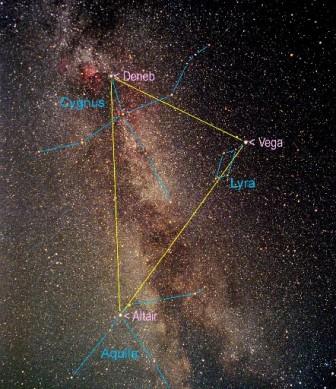
northern hemisphere folks can still see the summer triangle quite clearly overhead these days... made up of the stars vega, altair, and deneb.

Monday, August 4, 2008

night sky august 2008

this month provides many nice planetary alignments and the perseids meteor shower: usually the best of the year!

five planets will be visible with the naked eye this month: mercury, venus, mars, jupiter, and saturn!! starting on august 11th, we'll be able to see mercury, venus, and saturn approaching each other low on the western horizon. they'll be challenging to see since they are settling early with the sun, but all the planets are bright so they should be spottable... venus will be the brightest at magnitude -3.9, the mercury at -0.6 and saturn will be the faintest of the three at 0.8. mars hangs above the trio and jupiter shines brightly in the southern sky (see full night sky maps here).

august 13th provides a closeness between venus and saturn of less than a degree in the sky. if you hold out your arm at full length, your pointing index finger (one degree across) will easily block both planets! also on this night, the bright planet jupiter in the south will be 3 degrees north of the moon!

on august 16th, there will be a partial lunar eclipse visible from much of the world, best in africa and europe. since we just saw such a brilliant total solar eclipse due to the tight alignment of the sun, the moon, and the earth as the moon passed between the larger orbs, it's not surprising that the three are still aligned so tightly as the moon swings around the opposite side of the earth and passes thru our shadow!


after mid-august, saturn sinks in the sky each night, while mercury and venus rise higher. venus will shine brightly after sunset for the rest of the year, returning to its status as the "evening star." on august 20th, mercury and venus will be less than a degree apart, and both very bright!

the perseids meteor shower occurs between august 11-13th this year, peaking before dawn on august 12th for north american viewers. look below the sideways "W" of cassiopeia in the northeast to find the direction from which all the meteors will be shooting across the sky: the radiant. in reality, if you stand outside under the dark sky for a little while, you'll most likely see one bright streak or more overhead per minute after the gibbous moon sets at 1:30 am EDT.


enjoy!!

Saturday, March 1, 2008

moon covers venus this wednesday!

early-risers have quite a few interesting solar system alignments to entertain them for the next several mornings!

before the sun rises to outshine everything in the sky, three planets glow brightly toward the southeast: jupiter, venus, and mars. monday morning, march 3rd, the moon rises above the horizon just after jupiter, showing off its waning crescent to jupiter's lower left. the next morning, the sliver moon will shine between jupiter and the planet pair, venus and mercury! wednesday morning, the moon passes very close to mercury and venus... so close that the moon will pass in front of venus during the day!!


the lunar occultation of venus will be visible from many parts of north america (see map below). in austin, texas, we will be able to see the moon cover venus at 12:12pm (here's a table to determine times of occult for other locations - note that times are given in Universal Time so i subtracted 6 hours to get CST).


there are many times when venus is bright enough to be seen during the day, but it's a difficult (nearly impossible) task to see it when you don't know exactly where to look! this occultation will allow more of us to see venus during the day, because the much bigger target, the moon, will be so close! from texas, the crescent moon will be about 30 degrees up in the sky from the horizon, but still difficult to spot since only a tiny portion will be lit up by reflected sunlight. try to find the moon by looking southeast around noon, then look for venus just to the left of the moon.

i really enjoy seeing distant objects other than the sun in the sky during the day, so i'll be eating my lunch outside this wednesday!!

Tuesday, February 26, 2008

mercury and venus - together!

tomorrow morning about 45 minutes before sunrise, look to the east to see a very bright venus about 1.2 degrees below the usually-difficult-to-find planet mercury!

Related Posts Plugin for WordPress, Blogger...