for about a year after observations are taken with the hubble space telescope, no one but the original scientist who thought of the idea and took the observations is allowed to access the data. after this "embargo" period, anyone can access the data from an archive via the HST search form.
that is exactly what the imaging editor of sky & telescope magazine, Sean Walker, recently did! he took advantage of some newly released images of saturn and created this lovely video. in addition to watching the storm clouds in saturn's surface go round and round, you can see moons move and patterns in the rings as they spin around.
from el lobo rayado
Showing posts with label saturn. Show all posts
Showing posts with label saturn. Show all posts
Saturday, May 14, 2011
Wednesday, April 6, 2011
pluto, the previous planet: a song
a couple years ago i was walking to the bus stop with the song "rudolph the red nosed reindeer" stuck in my head, much to my frustration! in order to maintain my sanity, i started singing alternative lyrics based on the phrase that popped into my head: pluto the previous planet! i've been wanting to record this song and post it for the public ever since, but had never really been inspired.
so yesterday during the hack day portion of dotAstronomy meeting, i gathered a few fellow conference participants: astronomers, a great pianist, and an enthusiastic director.... and off we went!
so without futher ado... pluto, the previous planet!!
as much as i like the song as it is, the last verse might lead one to believe that i would like to reinstate pluto as a planet. i want to state for the record that this is NOT the case! i'm pleased that astronomers have decided on a definition of a planet that is based on some actual physics! the song is just fun and i hope people enjoy it.
with all this in mind, we also developed an accompanying website with a special message from pluto:
"First of all, thank you everyone for your concern, but really, I’m happy in my new role as the original dwarf planet! And there’s no need to worry, nothing physically happened to me to cause my reclassification. In fact, Charon’s been jealous for years that I was considered a planet, while we’ve been dancing around each other in our joint orbit around the sun. And don’t forget about our other two small satellites: Nix and Hydra! They may be small, but they’re important to me. And your Earth only has one Moon, so I feel special..."
here's the website: http://youpiter.org/pluto/
hope you enjoy!
so yesterday during the hack day portion of dotAstronomy meeting, i gathered a few fellow conference participants: astronomers, a great pianist, and an enthusiastic director.... and off we went!
so without futher ado... pluto, the previous planet!!
Pluto, the previous planet from carolune on Vimeo.
as much as i like the song as it is, the last verse might lead one to believe that i would like to reinstate pluto as a planet. i want to state for the record that this is NOT the case! i'm pleased that astronomers have decided on a definition of a planet that is based on some actual physics! the song is just fun and i hope people enjoy it.
with all this in mind, we also developed an accompanying website with a special message from pluto:
"First of all, thank you everyone for your concern, but really, I’m happy in my new role as the original dwarf planet! And there’s no need to worry, nothing physically happened to me to cause my reclassification. In fact, Charon’s been jealous for years that I was considered a planet, while we’ve been dancing around each other in our joint orbit around the sun. And don’t forget about our other two small satellites: Nix and Hydra! They may be small, but they’re important to me. And your Earth only has one Moon, so I feel special..."
here's the website: http://youpiter.org/pluto/
hope you enjoy!
Sunday, January 9, 2011

Friday, January 7, 2011
we're searching for ET, but it's really hard to see
some clever folks recently made a parody of Ke$ha's hit song, "We R Who We R." i've never heard that song or seen the video, but i don't really feel that i need to after this. its almost a little embarrassing to watch, because of the ridiculousness of modern pop style, but the lyrics are actually really good and the background images are gorgeous!
those of you following the continuing debate about the potential for life to survive on arsenic, might take offense to the song's notion that the discovery expands the possible types of lifeforms that can exist.
i will leave you with some of the reasonable response from the makers of the movie:
those of you following the continuing debate about the potential for life to survive on arsenic, might take offense to the song's notion that the discovery expands the possible types of lifeforms that can exist.
i will leave you with some of the reasonable response from the makers of the movie:
We’d like to defend our honor just a little bit in regards to the arsenic debate. Certainly, we know it is a very contentious subject, but we felt we couldn’t really do the whole controversy justice in the context of this parody, so we went with the brief mention. Are we trying to say this is a comprehensive look at everything about astrobiology? Of course not, and we understand you weren’t implying that it was supposed to be. But if we can pique the scientific curiosity of even a few young people, and get them interested in pursuing this field, that’s a win for us.
Wednesday, August 18, 2010
perseids and planets: evidence
did anyone get out to see the perseid meteor shower or the planets last week? in case you were clouded out or just not lucky this time around, you can see a nice 2010 perseids photo gallery, from which i've chosen a couple to share.
this is a shot by david harvey from mount lemmon in arizona, USA on august 12, 2010:

this capture comes from amir abolfath, from the alamut castle in iran, august 14, 2010:

today's APOD shows a lovely view of the current planetary alignment from a beach in portugal.

here's a key they provide so you can keep an eye out over the next few evenings! :)

this is a shot by david harvey from mount lemmon in arizona, USA on august 12, 2010:

this capture comes from amir abolfath, from the alamut castle in iran, august 14, 2010:

today's APOD shows a lovely view of the current planetary alignment from a beach in portugal.

here's a key they provide so you can keep an eye out over the next few evenings! :)

Wednesday, August 11, 2010
planets and the perseid meteor shower
tonight and the next few nights, the solar system treats us to the lovely sights of the perseid meteor shower. go outside and enjoy nature's display of meteors as the earth passes thru the interplanetary debris left by comet swift-tuttle.

you can also see where other people on earth have seen perseid meteors fly across the sky, or report your own sightings, via twitter, to help with the online project meteor watch.
even if you don't want to relax peacefully waiting for the meteor shower, you can pop out to see some excellent planetary alignments over the next few nights as well. venus is the super bright object in the west, and a bit to the south. mars hangs just above to the left and saturn above to the right. the sliver moon passes below this planetary triangle tomorrow night, aug 12th and to the left of the group on the 13th.


you can also see where other people on earth have seen perseid meteors fly across the sky, or report your own sightings, via twitter, to help with the online project meteor watch.
even if you don't want to relax peacefully waiting for the meteor shower, you can pop out to see some excellent planetary alignments over the next few nights as well. venus is the super bright object in the west, and a bit to the south. mars hangs just above to the left and saturn above to the right. the sliver moon passes below this planetary triangle tomorrow night, aug 12th and to the left of the group on the 13th.

Thursday, July 8, 2010
saturn's hexagon
here's a funny saturday morning breakfast cereal (SMBC) cartoon.


 indeed ;)
the hexagonal patterns around saturn's north pole were discovered by the voyager spacecraft flybys in the 1980s and quickly became mysterious phenomena. images taken by the cassini spacecraft since 2006 have shown how long-lived the hexagonal patterns in the clouds are, further extending the mystery. this image from cassini shows the thermal infrared glow (at 5 microns) of saturn's north pole:

circles and a definite hexagon! strange.
since astronomical objects are so far away in space, it is rare that laboratory experiments on earth can test theories about the inexplicably strange aspects of the solar system we observe with our telescopes and spacecraft, because we can rarely recreate the conditions that exist elsewhere in the universe (temperature, size, density, etc...).
but, a recent study by physicists Ana Claudia Barbosa Aguiar and Peter Read of the University of Oxford in the United Kingdom, has produced hexagonal patterns similar to those observed around saturn's north pole by releasing dye into a 30-liter cylinder tank of water spinning on a table. inside the tank of water, they place a small ring that whirls more rapidly than the cylinder and produces a jet stream.
the video below shows their experiment (behold, actual science on youtube!!!):
the study deduces that the speed of the spin of the inner ring relative to the cylinder determines the number of sides of the polygon formed. the larger the difference between the speed of the inner ring and the cylinder, the fewer sides the polygon had; they can produce triangles, squares, or "anything you like."
awesome.

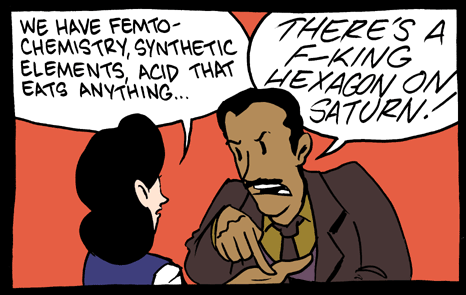
 indeed ;)
the hexagonal patterns around saturn's north pole were discovered by the voyager spacecraft flybys in the 1980s and quickly became mysterious phenomena. images taken by the cassini spacecraft since 2006 have shown how long-lived the hexagonal patterns in the clouds are, further extending the mystery. this image from cassini shows the thermal infrared glow (at 5 microns) of saturn's north pole:

circles and a definite hexagon! strange.
since astronomical objects are so far away in space, it is rare that laboratory experiments on earth can test theories about the inexplicably strange aspects of the solar system we observe with our telescopes and spacecraft, because we can rarely recreate the conditions that exist elsewhere in the universe (temperature, size, density, etc...).
but, a recent study by physicists Ana Claudia Barbosa Aguiar and Peter Read of the University of Oxford in the United Kingdom, has produced hexagonal patterns similar to those observed around saturn's north pole by releasing dye into a 30-liter cylinder tank of water spinning on a table. inside the tank of water, they place a small ring that whirls more rapidly than the cylinder and produces a jet stream.
the video below shows their experiment (behold, actual science on youtube!!!):
the study deduces that the speed of the spin of the inner ring relative to the cylinder determines the number of sides of the polygon formed. the larger the difference between the speed of the inner ring and the cylinder, the fewer sides the polygon had; they can produce triangles, squares, or "anything you like."
awesome.
Sunday, July 4, 2010
planets in the sky on july 4th
happy independence day to all folks from the US!! as the sun sets on your BBQs and you get ready for the fireworks to begin, take a moment to glance up in the sky at the natural firestorms glowing in other parts of our galaxy!
the planet venus is the very bright object visible in the west, which will set over the horizon as the sun says its goodbyes. if you follow up and to the left of venus, you'll spot the star regulus, mars, and saturn. this is roughly what the planet-heavy western sky will look like at 9:30 pm tonight from most of the US.

below shows a sky map for july 10, 2010 (from earthsky.org), as venus creeps closer to regulus in the sky. the two will reach a conjunction on july 10th, appearing extremely close in the sky for one night only!

for more info on any of these astronomical objects, i recommend you check out the site lookUP which provides interesting images of astronomical objects at different wavelengths, links to recent astronomy blog posts about them, finder charts, and much more. lookUP represents one of the many useful tools for the astronomically inclined recently developed by stuart at the astronomy blog.
happy hot dogging and planet hunting!
the planet venus is the very bright object visible in the west, which will set over the horizon as the sun says its goodbyes. if you follow up and to the left of venus, you'll spot the star regulus, mars, and saturn. this is roughly what the planet-heavy western sky will look like at 9:30 pm tonight from most of the US.

below shows a sky map for july 10, 2010 (from earthsky.org), as venus creeps closer to regulus in the sky. the two will reach a conjunction on july 10th, appearing extremely close in the sky for one night only!

for more info on any of these astronomical objects, i recommend you check out the site lookUP which provides interesting images of astronomical objects at different wavelengths, links to recent astronomy blog posts about them, finder charts, and much more. lookUP represents one of the many useful tools for the astronomically inclined recently developed by stuart at the astronomy blog.
happy hot dogging and planet hunting!
Saturday, May 22, 2010
saturn's aurora
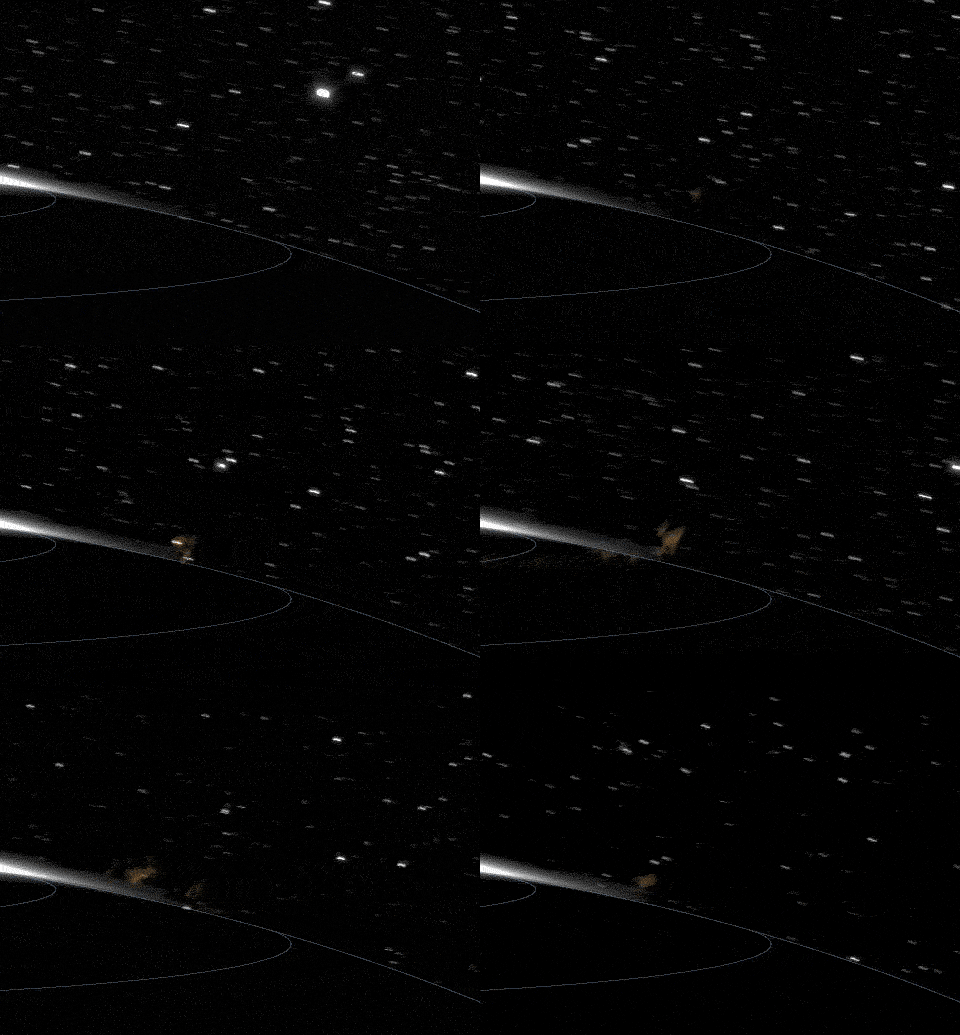
the spacecraft cassini continues to explore saturn's environment and captured this lovely timelapse of saturn's aurora between october 5th and 8th, 2009.

auroras (aurori? aurorae?) occur because energetic particles coming from the sun react with a planet's magnetic field. magnetic fields naturally have directional field lines which act as "traffic lanes" that guide the electrically charged solar wind particles to the north and south magnetic poles.
once concentrated at the poles, the particles begin to react with the gas in the planet's upper atmosphere. the atoms and molecules of the atmospheric gas absorb some of the energy of the foreign particles and become "excited." when they get exhausted from being excited, they return to their relaxed state by sending off a photon of light which we see collectively as the glow of an aurora.
the type of gas in the atmosphere that reacts with the solar particles determines the color of the aurora we see. on earth, the gas is mostly atomic oxygen (which produces a red glow), molecular nitrogen (blue), and molecular oxygen (green).
the animated image of saturn's aurora is almost as mesmerizing as voyager's approaching view of jupiter in the late 1970s.
auroras (aurori? aurorae?) occur because energetic particles coming from the sun react with a planet's magnetic field. magnetic fields naturally have directional field lines which act as "traffic lanes" that guide the electrically charged solar wind particles to the north and south magnetic poles.
once concentrated at the poles, the particles begin to react with the gas in the planet's upper atmosphere. the atoms and molecules of the atmospheric gas absorb some of the energy of the foreign particles and become "excited." when they get exhausted from being excited, they return to their relaxed state by sending off a photon of light which we see collectively as the glow of an aurora.
the type of gas in the atmosphere that reacts with the solar particles determines the color of the aurora we see. on earth, the gas is mostly atomic oxygen (which produces a red glow), molecular nitrogen (blue), and molecular oxygen (green).
the animated image of saturn's aurora is almost as mesmerizing as voyager's approaching view of jupiter in the late 1970s.
Wednesday, January 27, 2010
tethys plays peek-a-boo
saturn's moons play games with the space craft cassini in today's astronomy picture of the day. the tiny moon tethys pokes around the side of saturn's largest moon, titan.

you can see a huge crater on tethys in the image, and you can clearly see one of the most intriguing features of titan: the dense atmosphere that surrounds it! titan is the only satellite in our solar system known to have such a substantial atmosphere which places it on the top of the list of candidates to host some sort of microbial extraterrestrial life. there is currently discussion happening about future missions to explore titan more closely.
mike brown (aka - pluto killer!) wrote a great description of his team's discovery of some storms in titan's atmosphere.
you can watch a video of the entire occultation shown in the image above, or you can learn more about saturn from the sixty symbols video!

you can see a huge crater on tethys in the image, and you can clearly see one of the most intriguing features of titan: the dense atmosphere that surrounds it! titan is the only satellite in our solar system known to have such a substantial atmosphere which places it on the top of the list of candidates to host some sort of microbial extraterrestrial life. there is currently discussion happening about future missions to explore titan more closely.
mike brown (aka - pluto killer!) wrote a great description of his team's discovery of some storms in titan's atmosphere.
you can watch a video of the entire occultation shown in the image above, or you can learn more about saturn from the sixty symbols video!
Saturday, November 21, 2009
if earth had rings like saturn
here is a nice fantasy animation showing what the views might be from earth's surface if we had a ring system!
UPDATE: an interesting discussion on the implications of earth having rings is up at quantum rocketry.
UPDATE: an interesting discussion on the implications of earth having rings is up at quantum rocketry.
Tuesday, October 20, 2009
saturn's newly discovered ring
in this installment of the new sixty symbols, we discuss saturn's new ring, my favorite image of saturn ever, and why saturn's moon, mimas, is my favorite moon in the solar system!
Monday, September 28, 2009
saturn birthday cake
happy 30th birthday to regular reader john! his wife made him a very nice saturn birthday cake!!


Sunday, March 8, 2009
night sky - march 2009
the moon continues to fill up with light over the next few nights as it passes by the constellation, leo. look to the east in the early evening to watch the moon slowly approach saturn. tonight, 8 march, 2009, saturn is at opposition - it sits opposite the sun in our sky, so it's up all night! if you have access to a small telescope (local astronomy clubs, friends, etc...) or binoculars, take a look! saturn's rings are edge-on right now from our perspective on earth, but its a nice treat to see saturn and the moon only 8 degrees apart in the sky... as they will be tuesday night, 10 march, 2009, when the moon is full!!

it makes sense that the full moon appears near saturn in our sky when saturn is at opposition. the moon shines because it reflects sunlight. when the moon is full, sun shine covers the entire surface of the moon that is visible to us. this happens when the earth sits between the sun and the moon so that the sun shining from behind us illuminates the moon.

tuesday night, both saturn and the moon sit exactly opposite of the sun in earths sky!

this image of saturn was taken by the cassini space craft.

it makes sense that the full moon appears near saturn in our sky when saturn is at opposition. the moon shines because it reflects sunlight. when the moon is full, sun shine covers the entire surface of the moon that is visible to us. this happens when the earth sits between the sun and the moon so that the sun shining from behind us illuminates the moon.

tuesday night, both saturn and the moon sit exactly opposite of the sun in earths sky!

this image of saturn was taken by the cassini space craft.
Thursday, February 19, 2009
saturn's quadruple transit
right now, saturn's rings sit in an edge-on position relative to earth... saturn is sideways. christopher go took advantage of this position to image the moon, titan, as it transited in front of the ringed planet on feb. 8, 2009. he used an 11-inch telescope to create this little movie:

go's movie shows a preview of the event happening on february 24th, 2009! not only will that date treat us to comet lulin's closest approach, we will also see *four* of saturn's moons pass directly in front of the planet at the same time: titan, mimas, dione and enceladus!!! a quadruple transit!
saturn will sit very close to comet lulin on feb 24, 2009, so get your telescopes ready and look to the southwest before dawn!!


go's movie shows a preview of the event happening on february 24th, 2009! not only will that date treat us to comet lulin's closest approach, we will also see *four* of saturn's moons pass directly in front of the planet at the same time: titan, mimas, dione and enceladus!!! a quadruple transit!
saturn will sit very close to comet lulin on feb 24, 2009, so get your telescopes ready and look to the southwest before dawn!!

Monday, January 12, 2009
sideways saturn
i guess it depends on which side you think is saturn's front to determine whether its sideways right now. i think in our minds we all visualize saturn's rings as a dominant feature of the sixth planet from the sun, and how can we not when our little space robots take pictures like this for us to enjoy!!

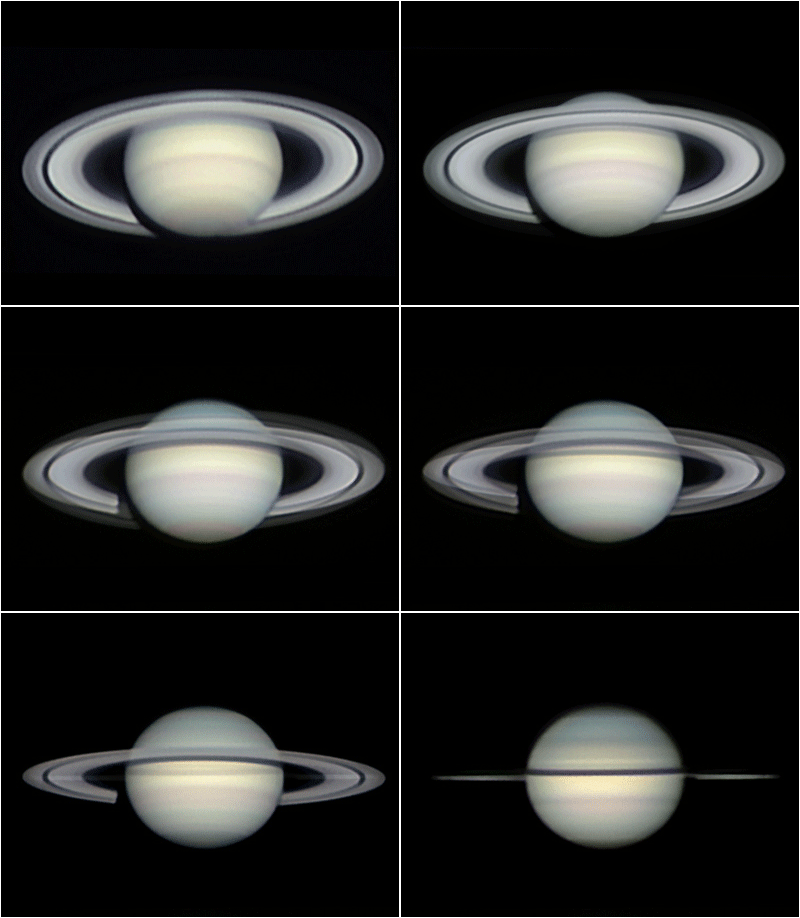
while spacecrafts can zoom around objects to get different views, we are stuck with the perspective provided to the surface of the earth. from our vantage point, saturn's rings dont always appear at such an angle that we can see their extended beauty. saturn slowly rotates with respect to the earth, so that the rings sit at different inclination angles. richard bosman nicely demonstrates our varying views of saturn in this series of images taken over the period of time from 2005 to new years day 2009.

right now, saturn's rings are horizontal to the earth, with the rings very very thin and narrow... a position i think of as "sideways!" if you have the chance, view our ringed neighbor thru a telescope, via a local astronomy society, your own telescope, or a friends. saturn will not be properly viewable from the earth in this orientation again until 2038!
late this evening, 13 january 2009, provides a lovely chance to view saturn, the big, bright moon, and the star, regulus, lined up along the ecliptic.

enjoy the views!

while spacecrafts can zoom around objects to get different views, we are stuck with the perspective provided to the surface of the earth. from our vantage point, saturn's rings dont always appear at such an angle that we can see their extended beauty. saturn slowly rotates with respect to the earth, so that the rings sit at different inclination angles. richard bosman nicely demonstrates our varying views of saturn in this series of images taken over the period of time from 2005 to new years day 2009.
right now, saturn's rings are horizontal to the earth, with the rings very very thin and narrow... a position i think of as "sideways!" if you have the chance, view our ringed neighbor thru a telescope, via a local astronomy society, your own telescope, or a friends. saturn will not be properly viewable from the earth in this orientation again until 2038!
late this evening, 13 january 2009, provides a lovely chance to view saturn, the big, bright moon, and the star, regulus, lined up along the ecliptic.

enjoy the views!
Monday, August 4, 2008
night sky august 2008
this month provides many nice planetary alignments and the perseids meteor shower: usually the best of the year!
five planets will be visible with the naked eye this month: mercury, venus, mars, jupiter, and saturn!! starting on august 11th, we'll be able to see mercury, venus, and saturn approaching each other low on the western horizon. they'll be challenging to see since they are settling early with the sun, but all the planets are bright so they should be spottable... venus will be the brightest at magnitude -3.9, the mercury at -0.6 and saturn will be the faintest of the three at 0.8. mars hangs above the trio and jupiter shines brightly in the southern sky (see full night sky maps here).
august 13th provides a closeness between venus and saturn of less than a degree in the sky. if you hold out your arm at full length, your pointing index finger (one degree across) will easily block both planets! also on this night, the bright planet jupiter in the south will be 3 degrees north of the moon!
on august 16th, there will be a partial lunar eclipse visible from much of the world, best in africa and europe. since we just saw such a brilliant total solar eclipse due to the tight alignment of the sun, the moon, and the earth as the moon passed between the larger orbs, it's not surprising that the three are still aligned so tightly as the moon swings around the opposite side of the earth and passes thru our shadow!

after mid-august, saturn sinks in the sky each night, while mercury and venus rise higher. venus will shine brightly after sunset for the rest of the year, returning to its status as the "evening star." on august 20th, mercury and venus will be less than a degree apart, and both very bright!
the perseids meteor shower occurs between august 11-13th this year, peaking before dawn on august 12th for north american viewers. look below the sideways "W" of cassiopeia in the northeast to find the direction from which all the meteors will be shooting across the sky: the radiant. in reality, if you stand outside under the dark sky for a little while, you'll most likely see one bright streak or more overhead per minute after the gibbous moon sets at 1:30 am EDT.

enjoy!!
five planets will be visible with the naked eye this month: mercury, venus, mars, jupiter, and saturn!! starting on august 11th, we'll be able to see mercury, venus, and saturn approaching each other low on the western horizon. they'll be challenging to see since they are settling early with the sun, but all the planets are bright so they should be spottable... venus will be the brightest at magnitude -3.9, the mercury at -0.6 and saturn will be the faintest of the three at 0.8. mars hangs above the trio and jupiter shines brightly in the southern sky (see full night sky maps here).
august 13th provides a closeness between venus and saturn of less than a degree in the sky. if you hold out your arm at full length, your pointing index finger (one degree across) will easily block both planets! also on this night, the bright planet jupiter in the south will be 3 degrees north of the moon!
on august 16th, there will be a partial lunar eclipse visible from much of the world, best in africa and europe. since we just saw such a brilliant total solar eclipse due to the tight alignment of the sun, the moon, and the earth as the moon passed between the larger orbs, it's not surprising that the three are still aligned so tightly as the moon swings around the opposite side of the earth and passes thru our shadow!

after mid-august, saturn sinks in the sky each night, while mercury and venus rise higher. venus will shine brightly after sunset for the rest of the year, returning to its status as the "evening star." on august 20th, mercury and venus will be less than a degree apart, and both very bright!
the perseids meteor shower occurs between august 11-13th this year, peaking before dawn on august 12th for north american viewers. look below the sideways "W" of cassiopeia in the northeast to find the direction from which all the meteors will be shooting across the sky: the radiant. in reality, if you stand outside under the dark sky for a little while, you'll most likely see one bright streak or more overhead per minute after the gibbous moon sets at 1:30 am EDT.

enjoy!!
Wednesday, July 16, 2008
cassini continues...
the cassini space craft that is floating around saturn has finished its 4 year mission. many fantastic images have come from this mission, and luckily for us, cassini started an extended 2-year mission on july 1, 2008!!
here are a couple anniversary shots recently released....

in this picture you can see the moon, mimas, in the top left and you can see the shadow of the moon, enceladus, on the surface of saturn.

in both images you can see the shadows of the rings on the northern hemisphere of the planet. over the next year, we will see less and less of the ring shadows, both from cassini and from earth, as the plane of the rings lines up with the sun. the ring shadows line up exactly with saturn's horizon during saturns vernal equinox on august 11, 2009! afterwards, the shadows will appear on the southern hemisphere of the planet.
you can still see saturn in the western horizon at sunset, with mars nearby!

here are a couple anniversary shots recently released....

in this picture you can see the moon, mimas, in the top left and you can see the shadow of the moon, enceladus, on the surface of saturn.

in both images you can see the shadows of the rings on the northern hemisphere of the planet. over the next year, we will see less and less of the ring shadows, both from cassini and from earth, as the plane of the rings lines up with the sun. the ring shadows line up exactly with saturn's horizon during saturns vernal equinox on august 11, 2009! afterwards, the shadows will appear on the southern hemisphere of the planet.
you can still see saturn in the western horizon at sunset, with mars nearby!

Monday, June 16, 2008
the skies of june 2008
TONIGHT, the nearly full moon and the bright star, antares line up.
WEDNESDAY, june 18th, reveals june's full moon!
THURSDAY night, june 19th, begins the ascent of the moon near jupiter. the two rise above the south-eastern horizon late in the evening with the very bright jupiter to the left of the moon. jupiter reaches opposition on july 9th (when the sun, earth and jupiter line up with earth in the middle), so it is very bright in our sky these days! this would be a great night for some late-night binocular or telescope viewing! try to find the 4 galilean moons of jupiter and guess which is which!

FRIDAY marks the summer solstice and the longest day of the year for those of us in the northern hemisphere. this (early solstice) is the day the sun is as far north in the sky as it will get all year. those in the southern hemisphere celebrate their winter solstice as they begin to welcome longer days each day of the rest of the year!
SATURDAY, june 21st, is the first official day of summer in the north.... but it has been a brutually hot spring in this part of the world so i'm not really thrilled about the official hot season just beginning now!
SUNDAY night, look to the west just at sunset to see a beautiful trio of saturn, the star regulus, and the planet mars (upper left to lower right) with saturn being the brightest!
enjoy!
WEDNESDAY, june 18th, reveals june's full moon!
THURSDAY night, june 19th, begins the ascent of the moon near jupiter. the two rise above the south-eastern horizon late in the evening with the very bright jupiter to the left of the moon. jupiter reaches opposition on july 9th (when the sun, earth and jupiter line up with earth in the middle), so it is very bright in our sky these days! this would be a great night for some late-night binocular or telescope viewing! try to find the 4 galilean moons of jupiter and guess which is which!

FRIDAY marks the summer solstice and the longest day of the year for those of us in the northern hemisphere. this (early solstice) is the day the sun is as far north in the sky as it will get all year. those in the southern hemisphere celebrate their winter solstice as they begin to welcome longer days each day of the rest of the year!
SATURDAY, june 21st, is the first official day of summer in the north.... but it has been a brutually hot spring in this part of the world so i'm not really thrilled about the official hot season just beginning now!
SUNDAY night, look to the west just at sunset to see a beautiful trio of saturn, the star regulus, and the planet mars (upper left to lower right) with saturn being the brightest!
enjoy!
Monday, June 9, 2008
saturn, mars and the moon in june
if you saw the crescent moon in the sky last night after sunset, you saw the star regulus and planet venus just above it and the planet mars off to the right. tonight, the moon shoots past regulus and saturn to the left, providing a nice alignment of all these objects.

pay attention over the next month as mars approaches saturn in the sky as it moves along the ecliptic more quickly than the ringed planet. next month, when the moon passes by these planets, they will be within a few degrees of each other, culminating in a less-than-one-degree-separation of the two planets on july 10th!

pay attention over the next month as mars approaches saturn in the sky as it moves along the ecliptic more quickly than the ringed planet. next month, when the moon passes by these planets, they will be within a few degrees of each other, culminating in a less-than-one-degree-separation of the two planets on july 10th!
Subscribe to:
Posts (Atom)


