i'm at the parkes radio observatory right now, in central/western NSW, australia. the 64 meter diameter dish (HUGE!) is one of the largest single dishes in the world and remains one of the most scientifically productive, despite turning 50 years old this year!
last night, we were treated to the sight of the international space station, with the shuttle endeavour docked to it during its last mission ever, passing right behind the dish in the sky! it was a lovely moment.
Showing posts with label night sky. Show all posts
Saturday, May 21, 2011
parkes radio dish and the ISS
Saturday, February 19, 2011
upsidedown or not: orion is always there
Sunday, January 23, 2011
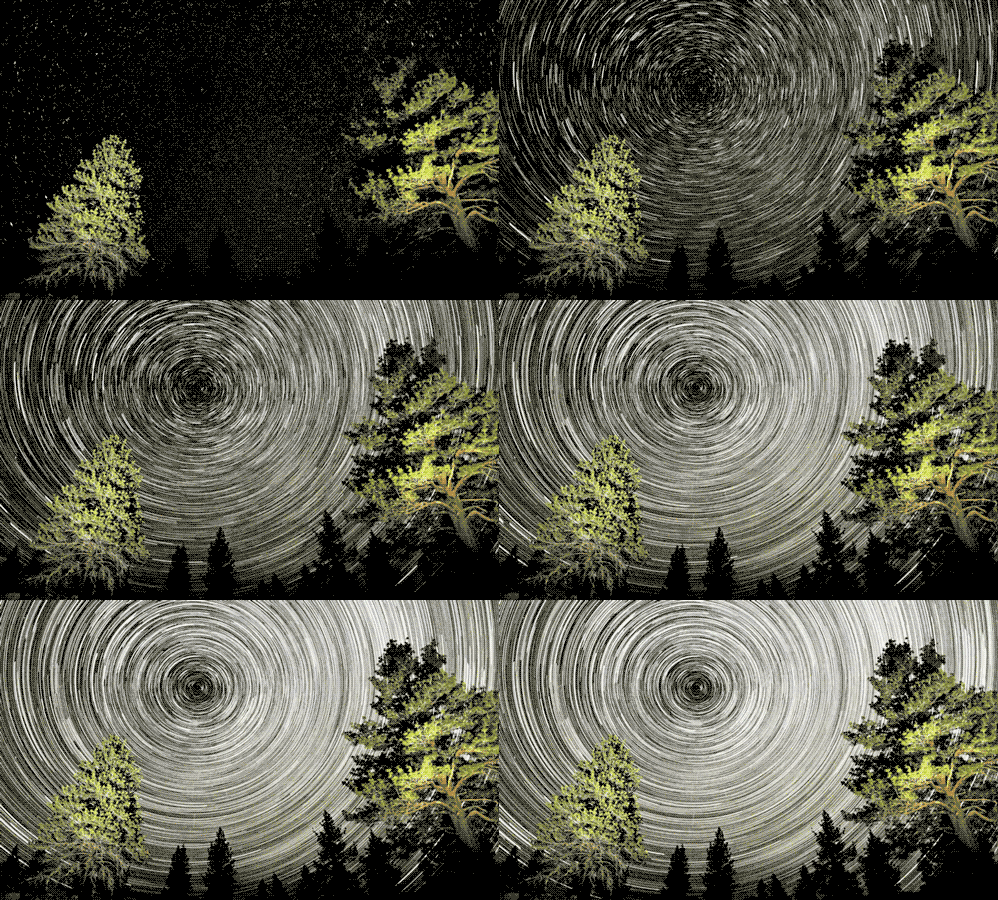
round and round we go
Thursday, January 6, 2011
partially eclipsed sun rising
the partial solar eclipse that occurred on 4th january 2011 was not visible from my part of the world, unfortunately. but many people achieved some fantastic photos of the event, including this shot featured on APOD today taken in austria by robert pölzl.
lucky for us earthlings, there will be another 3 partial solar eclipses and 2 total lunar eclipses in 2011! most of them are visible from rather remote places on the globe, but i'm sure some folks will venture to take photos for the rest of us!
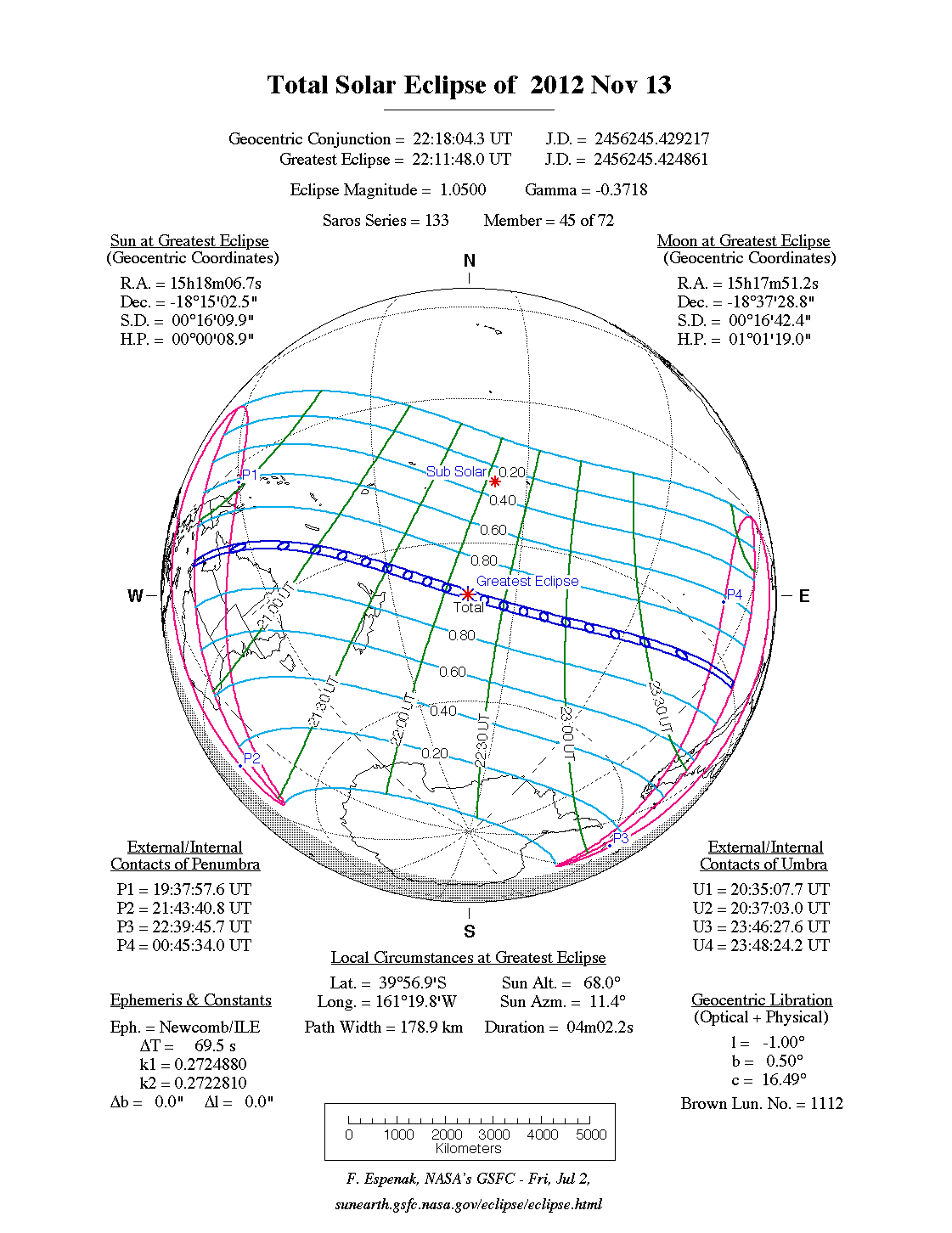
the next total solar eclipse takes place on 13th november 2012 and will be visible from the very north of australia! i'll absolutely, positively be there! anyone else?
lucky for us earthlings, there will be another 3 partial solar eclipses and 2 total lunar eclipses in 2011! most of them are visible from rather remote places on the globe, but i'm sure some folks will venture to take photos for the rest of us!
the next total solar eclipse takes place on 13th november 2012 and will be visible from the very north of australia! i'll absolutely, positively be there! anyone else?
Labels:
astronomy,
astrophotography,
moon,
night sky,
perspective
Saturday, December 11, 2010
geminids meteor shower
usually the best meteor shower of the year is the geminids meteor shower which this year peaks on monday night, 13th december! every december the earth passes through the debris tail of the asteroid 3200 Phaethon, but the details of why this asteroid has so much debris are not fully understood, which makes the strength of the celestial show an enticing mystery.
so bundle up, go out, and enjoy the show!
Wednesday, September 22, 2010
the north star, polaris
this beautiful artwork shows you how to find the north star using ursa major, the big dipper.

Encyclopédie du livre d’or pour garçons et filles-livre 6 Adaptation américaine
(Editions des deux coqs d’or-1972, Illustrateur: inconnu)
(via fresh photons

Encyclopédie du livre d’or pour garçons et filles-livre 6 Adaptation américaine
(Editions des deux coqs d’or-1972, Illustrateur: inconnu)
(via fresh photons
Tuesday, September 21, 2010
jupiter's opposition, the equinox, and the full moon
tomorrow is the equinox, which means that the hours of daylight and darkness are very nearly equal. welcome to a new season (and hopefully lots of colorful leaves in the trees in ohio when i visit next week!).
the next few evenings will also be lovely for looking towards the sky. maybe you've noticed an incredibly bright object shining in eastern skies over the last couple months? that's the planet jupiter. wednesday, the harvest moon will be full, and the brightly shining, nearby jupiter will be hanging in the sky just below it.

last night jupiter was at opposition (when the earth passes between the sun and jupiter), constituting jupiter's closest physical approach to us on earth! every earth year, jupiter goes thru an opposition position, but its physically a little closer or farther each time. this time, it happens to be closer than it has been since 1963 and closer than it will be again until the year 2022, and as such, it looks especially bright in our sky! the jovian giant is about 368 million miles away.
you can see below how the planets of our solar system are currently aligned (the map is not to scale).

earth is just to the right of the sun, and you can see jupiter in a straight line farther out to the right. even farther out is the planet uranus. in fact, if you look to the upper left of jupiter in the (northern hemisphere's) sky with the aid of binoculars or a small telescope, you should easily be able to spot uranus, and maybe even the 4 galilean moons of jupiter! from the southern hemisphere, you'll find uranus to the lower left of jupiter.
be sure to go out, take a look, take a picture, and enjoy the changing of the seasons.
the next few evenings will also be lovely for looking towards the sky. maybe you've noticed an incredibly bright object shining in eastern skies over the last couple months? that's the planet jupiter. wednesday, the harvest moon will be full, and the brightly shining, nearby jupiter will be hanging in the sky just below it.

last night jupiter was at opposition (when the earth passes between the sun and jupiter), constituting jupiter's closest physical approach to us on earth! every earth year, jupiter goes thru an opposition position, but its physically a little closer or farther each time. this time, it happens to be closer than it has been since 1963 and closer than it will be again until the year 2022, and as such, it looks especially bright in our sky! the jovian giant is about 368 million miles away.
you can see below how the planets of our solar system are currently aligned (the map is not to scale).

earth is just to the right of the sun, and you can see jupiter in a straight line farther out to the right. even farther out is the planet uranus. in fact, if you look to the upper left of jupiter in the (northern hemisphere's) sky with the aid of binoculars or a small telescope, you should easily be able to spot uranus, and maybe even the 4 galilean moons of jupiter! from the southern hemisphere, you'll find uranus to the lower left of jupiter.
be sure to go out, take a look, take a picture, and enjoy the changing of the seasons.
Wednesday, August 11, 2010
planets and the perseid meteor shower
tonight and the next few nights, the solar system treats us to the lovely sights of the perseid meteor shower. go outside and enjoy nature's display of meteors as the earth passes thru the interplanetary debris left by comet swift-tuttle.

you can also see where other people on earth have seen perseid meteors fly across the sky, or report your own sightings, via twitter, to help with the online project meteor watch.
even if you don't want to relax peacefully waiting for the meteor shower, you can pop out to see some excellent planetary alignments over the next few nights as well. venus is the super bright object in the west, and a bit to the south. mars hangs just above to the left and saturn above to the right. the sliver moon passes below this planetary triangle tomorrow night, aug 12th and to the left of the group on the 13th.

you can also see where other people on earth have seen perseid meteors fly across the sky, or report your own sightings, via twitter, to help with the online project meteor watch.
even if you don't want to relax peacefully waiting for the meteor shower, you can pop out to see some excellent planetary alignments over the next few nights as well. venus is the super bright object in the west, and a bit to the south. mars hangs just above to the left and saturn above to the right. the sliver moon passes below this planetary triangle tomorrow night, aug 12th and to the left of the group on the 13th.
Tuesday, August 3, 2010
dirty space news: solar mass ejections
solar scientists are reporting that the sun has recently experienced FOUR solar mass ejections and soon the earth's atmosphere will glow in the aftermath.
an aurora occurs because energetic particles coming from the sun react with a planet's magnetic field. magnetic fields naturally have directional field lines which act as "traffic lanes" that guide the electrically charged solar particles to the north and south magnetic poles.
for updates on aurora sightings, go to space weather.
an aurora occurs because energetic particles coming from the sun react with a planet's magnetic field. magnetic fields naturally have directional field lines which act as "traffic lanes" that guide the electrically charged solar particles to the north and south magnetic poles.
for updates on aurora sightings, go to space weather.
Sunday, May 16, 2010
crescent moon and venus tonight!
if you have clear skies today, look for the tiny crescent moon and try to spot venus nearby! its rare (and exciting, i think) to see another planet during the day.

the pair will be brilliant in the evening sky as well!

the pair will be brilliant in the evening sky as well!
Wednesday, January 27, 2010
hola mars
right now our neighbor mars is as physically as close as it ever gets to us, a position called opposition. mars is the bright orange speckle rising in the eastern sky.

to get ahold of mars' position in our sky for the next couple months, look up a bit after sunset on friday, the 29th of january, and see our nearly full moon sitting just next to mars in the sky for the evening.

to get ahold of mars' position in our sky for the next couple months, look up a bit after sunset on friday, the 29th of january, and see our nearly full moon sitting just next to mars in the sky for the evening.
Saturday, December 26, 2009
lunar eclipse on new years eve!
the last eclipse of 2009 will occur on new years eve! everyone around the world will see a full moon that night, and it will be a blue moon - the second full moon occurring in a month. look to the east, in the constellation gemini.
image from earth sky.
on new years eve, the earth will float almost directly between the sun and the moon, causing a partial lunar eclipse. the greatest eclipse occurs at 19:23 UT, when the edge of the moon passes thru the earth's shadow. this eclipse will be visible to people in europe, africa, asia, india, and some of australia - too bad americas! but you will have this view during the first few nights of 2010, as the moon passes close by mars on january 2nd!

the above map comes from sky and telescope, who state that "the Moon is plotted for North America; in Europe, move each Moon symbol a quarter for the way toward the one for the previous date."
image from earth sky.on new years eve, the earth will float almost directly between the sun and the moon, causing a partial lunar eclipse. the greatest eclipse occurs at 19:23 UT, when the edge of the moon passes thru the earth's shadow. this eclipse will be visible to people in europe, africa, asia, india, and some of australia - too bad americas! but you will have this view during the first few nights of 2010, as the moon passes close by mars on january 2nd!

the above map comes from sky and telescope, who state that "the Moon is plotted for North America; in Europe, move each Moon symbol a quarter for the way toward the one for the previous date."
Tuesday, September 22, 2009
timescapes timelapse: mountain light
tom @ timescapes is working on a follow-up to his breathtaking short film learning to fly. he has offered a preview while we wait on the edge of our seats....
Timescapes Timelapse: Mountain Light from Tom @ Timescapes on Vimeo.
Labels:
art,
astrophotography,
night sky,
perspective,
technology,
video
Saturday, August 22, 2009
space day and moon watch
mark your calendars... we're putting on a "space day and moon watch" event at nottingham castle on october 31st (halloween!), 2009! i'm really excited for it, even though it's quite a complicated series of tasks to organize such a huge event!

thanks and props to mark hammonds (of supernova condensate) for designing the great poster.

thanks and props to mark hammonds (of supernova condensate) for designing the great poster.
Monday, August 17, 2009
the milky way and trees!
here's another gorgeous shot of the milky way by tom @ timescapes. cant wait to see the full timelaspe series from this shoot!
Tuesday, August 11, 2009
perseid meteor shower!
the perseid meteor shower peaks late tonight and early tomorrow night, august 12th. go out to see some burning bits of comet dust as the earth passes thru the debris left by comet swift-tuttle. if you have clear skies, look up to the northeast after 11 pm tonight!


enjoy!


enjoy!
Wednesday, June 10, 2009
the summer triangle
its summertime in the northern hemisphere which means its a good time to look for the summer triangle asterism! if you go outside as the sun sets and face east, most likely the three brightest stars you see make up what we call the summer triangle.

each star in the summer triangle belongs to its own unique constellation. altair lives in the constellation aquila (the eagle), vega is part of the constellation lyra (the harp), and deneb acts as the head of the constellation cygnus (the swan). a "constellation" is one of 88 stellar groupings officially adopted by the international astronomical union based on ancient identifications, while "asterisms" are more modern associations of stars.

happy hunting!

each star in the summer triangle belongs to its own unique constellation. altair lives in the constellation aquila (the eagle), vega is part of the constellation lyra (the harp), and deneb acts as the head of the constellation cygnus (the swan). a "constellation" is one of 88 stellar groupings officially adopted by the international astronomical union based on ancient identifications, while "asterisms" are more modern associations of stars.

happy hunting!
Wednesday, April 1, 2009
yuri's night - april 4-12, 2009
yuri's night: dream. explore. celebrate.
Friday, March 27, 2009
100 hours of astronomy
from april 2nd to the 5th, people all over the world will be celebrating 100 hours of astronomy. the goal is to get as many people to look thru a telescope as possible! the dates correspond with the first quarter moon, which is my favorite object to view thru small telescopes, and saturn is up right now as well! many local astronomy societies will be holding events, most universities have some sort of telescope they use for public observing, or visit the official site to see what is being planned around your town!

there will be several events you can follow online if the weather doesnt cooperate with your evening sky gazing: around the world in 80 telescopes allows you to see tours by professional astronomers of some of the world's most advanced observatories!
click here to view all the other online activities planned for both adults and children during the 100 hours of astronomy!
enjoy!

there will be several events you can follow online if the weather doesnt cooperate with your evening sky gazing: around the world in 80 telescopes allows you to see tours by professional astronomers of some of the world's most advanced observatories!
click here to view all the other online activities planned for both adults and children during the 100 hours of astronomy!
enjoy!
Tuesday, March 24, 2009
inferior conjunction for venus
venus is now approaching the the sun in our sky. venus is currently on the same side of the sun as the earth, so it is close to the earth right now. the point when venus is exactly between the earth and the sun is called inferior conjunction, and occurs on 29 march, 2009.

after venus passes thru inferior conjunction, it will move to being the earth's "morning star" although for the next few days, you can spot venus in the early evening and in the early morning!
because of the relative positions of venus, the earth, and the sun, it goes thru phases, similar to the phases of the moon. the new moon occurs when the moon is directly between the earth and the sun, so you can understand why venus actually looks like a little sliver right now, even though it seems so bright in our sky! we will see a "new" venus at inferior conjunction.
here are photos as venus has approached inferior conjunction over the last several days!

after venus passes thru inferior conjunction, it will move to being the earth's "morning star" although for the next few days, you can spot venus in the early evening and in the early morning!
because of the relative positions of venus, the earth, and the sun, it goes thru phases, similar to the phases of the moon. the new moon occurs when the moon is directly between the earth and the sun, so you can understand why venus actually looks like a little sliver right now, even though it seems so bright in our sky! we will see a "new" venus at inferior conjunction.
here are photos as venus has approached inferior conjunction over the last several days!
Subscribe to:
Posts (Atom)